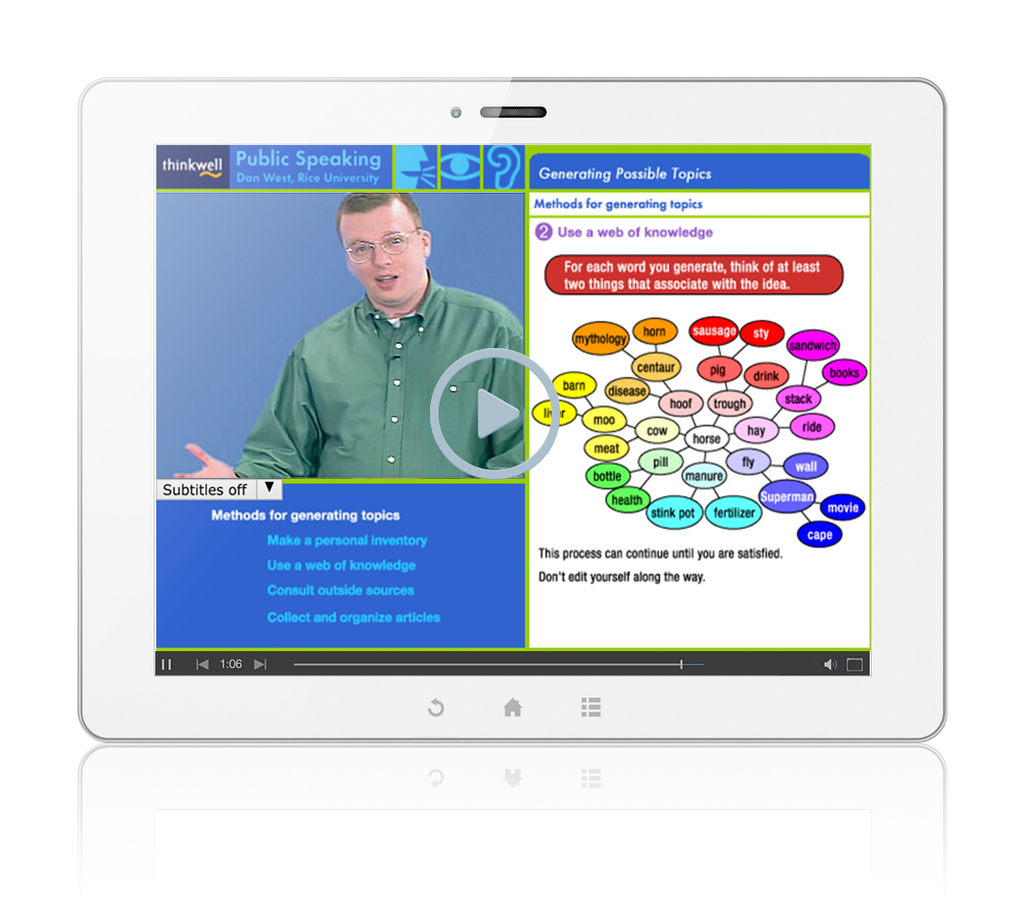
Public Speaking
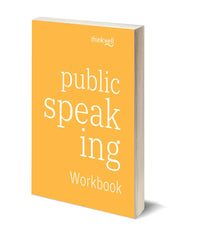
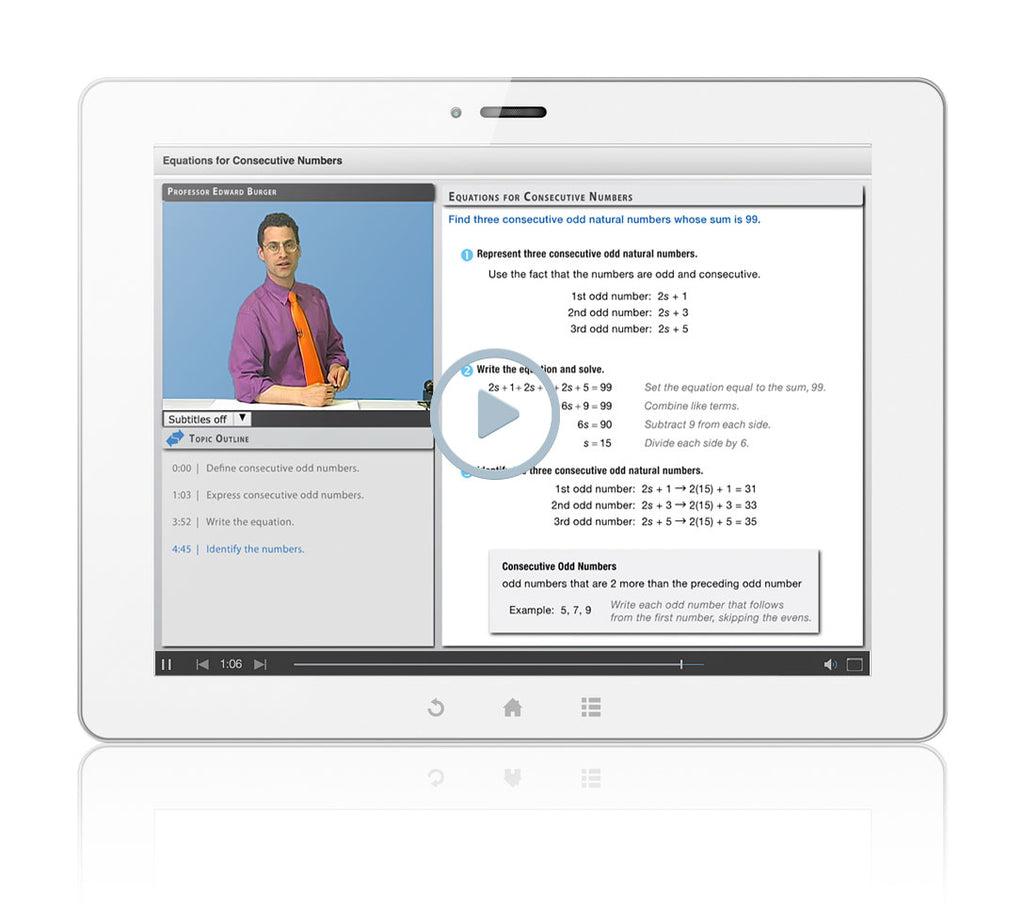
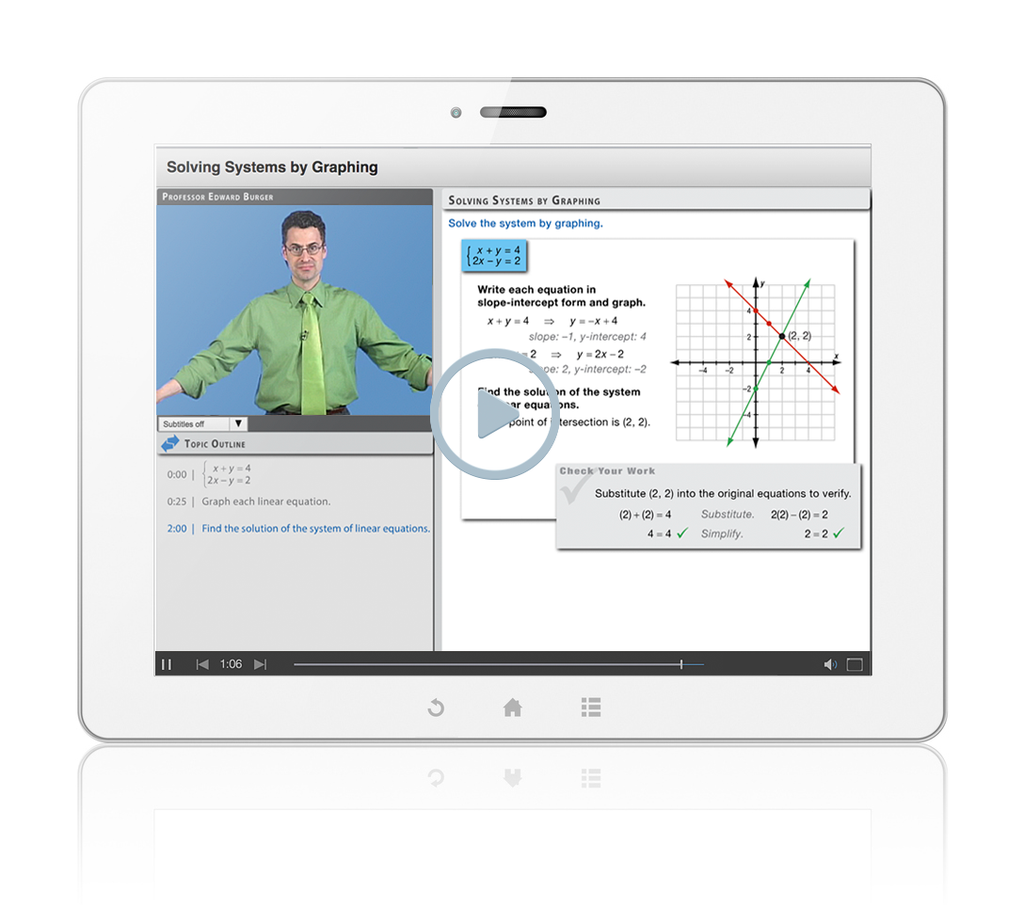
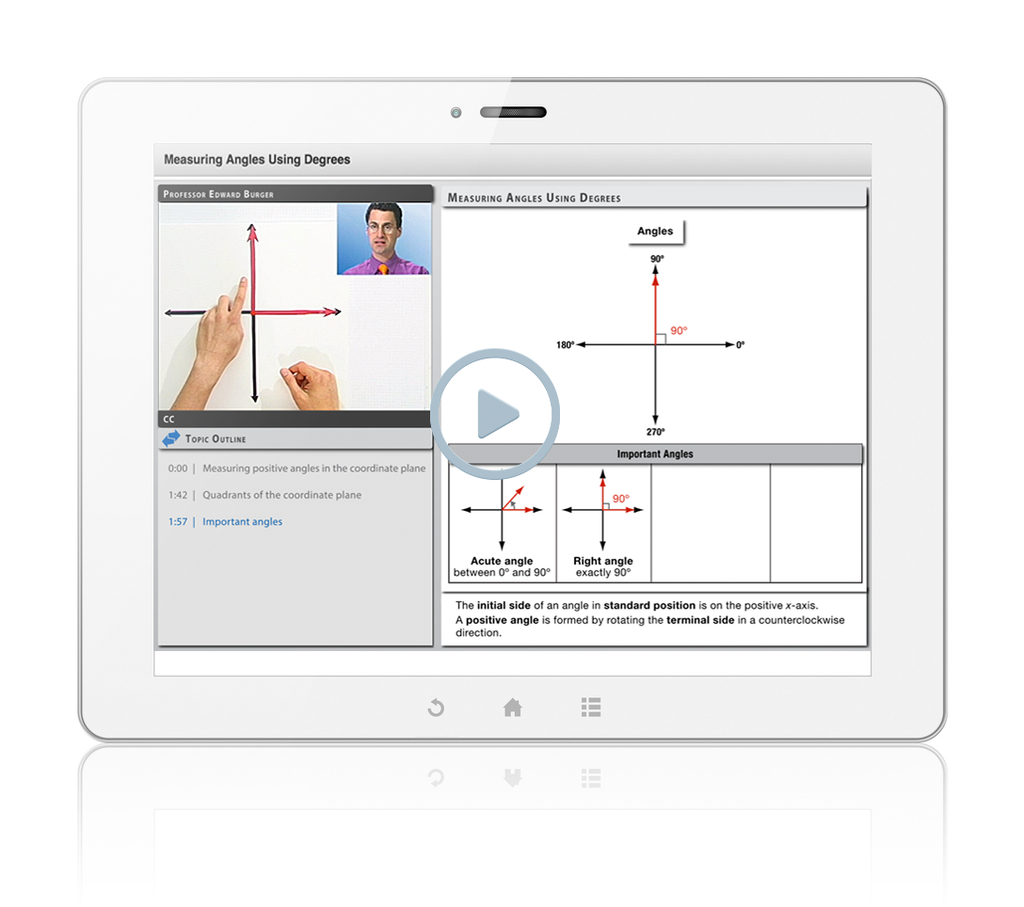
- 12-month Online Subscription to our complete Public Speaking course with video lessons, day-by-day lesson plans, automatically graded exercises, and much more.
- CD Set (optional) contains all of the video lessons so that you can watch them when you're away from the internet.
- Printed Notes (optional) are the Public Speaking course notes from the Online Subscription printed in a black & white on-the-go format.
Public Speaking details
Thinkwell's Public Speaking is a one-semester college course, though the topics covered in high school are very similar. Public Speaking, or Speech, is a recommended college prep course.
The course is considered a "performance course," where students practice the art of public speaking by getting useful public speaking tips and delivering 3 or 4 short speeches throughout the semester. This is a great way to cover a high school elective while overcoming a fear of public speaking.
- Equivalent to 11th- or 12th-grade Public Speaking
- More than 140 video lessons
- 80 available contact hours (What is this?)
- 1000+ automatically graded problems with immediate feedback allow you to track your progress (See sample)
- 31-week lesson plan with daily assignments (see lesson plan)
- Printable illustrated black & white notes for each topic
- Closed captioning for all videos
- Searchable glossary of more than 150 public-speaking terms
- Engaging content to help students improve their public speaking skills:
- Benefits, history, and theory of communication
- Ethical speaking practices
- Overcoming speaker anxiety
- Speaking inclusively
- Audience analysis
- Selecting, developing, and researching a topic
- Organizing and outlining a speech
- Effective speech delivery
- Using visual aids
- Principles of informative and persuasive speeches
- Notable speeches from figures such as John F. Kennedy, Martin Luther King, Jr., Barbara Jordan, Geraldine Ferraro, and Ronald Reagan
About the Authors
Table of Contents
(Expand All - Close All)1. Introduction to Public Speaking
- 1.1 Benefits, History, and Theories of Communication
- 1.1.1 Why Public Speaking is Important to You
- 1.1.2 Student Voices: "Let me tell you..."
- 1.1.3 The Legacy of Public Speaking
- 1.1.4 Categories of Communication
- 1.1.5 Models of Communication
- 1.2 The Public Speaking Situation
- 1.2.1 Elements of Public Speaking
- 1.2.2 Critical Thinking
- 1.2.3 Notable Speeches for Analysis: Lyndon B. Johnson
- 1.3 Ethics
- 1.3.1 Ethical Principles
- 1.3.2 Ethical Practices of Speakers and Listeners
- 1.3.3 Freedom of Speech
- 1.3.4 Hate Speech and Political Correctness
- 1.4 Speaker Anxiety
- 1.4.1 Pervasiveness and Symptoms of Speaker Anxiety
- 1.4.2 Psychological Management of Speaker Anxiety
- 1.4.3 Student Voices: "I got used to it..."
- 1.4.4 Physical Management of Speaker Anxiety
2. The Audience
- 2.1 Listening
- 2.1.1 The Nature of Listening
- 2.1.2 Effective Listening in Practice
- 2.1.3 Ways for Speakers to Assist Listeners
- 2.1.4 Becoming a More Effective Listener
- 2.2 Evaluation
- 2.2.1 Evaluation of Speeches as a Responsible Listener
- 2.2.2 Student Voices: Samples of Effective and Ineffective Feedback
- 2.3 Diversity: Speaking Inclusively
- 2.3.1 The Meaning of Inclusion
- 2.3.2 The Consequences of Exclusion
- 2.3.3 The Opportunities of Diversity
- 2.3.4 Notable Speeches for Analysis: Jesse Jackson
- 2.4 Audience Analysis
- 2.4.1 The Importance of Audience Analysis
- 2.4.2 Knowing Your Audience
- 2.4.3 Notable Speeches for Analysis: Robert F. Kennedy
- 2.4.4 Analyzing the Situation
- 2.4.5 Adapting to Your Audience
- 2.4.6 Notable Speeches for Analysis: Barbara Bush
3. First Steps
- 3.1 The First Speech
- 3.1.1 Keeping the First Assignment in Perspective
- 3.1.2 Student Speeches for Analysis: Typical First Speech Assignment
- 3.1.3 Developing the First Speech
- 3.1.4 Delivering the First Speech
- 3.1.5 Following Up
- 3.1.6 Student Voices: "I did it..."
- 3.2 Selecting Your Topic
- 3.2.1 Assessing Possible Topics
- 3.2.2 Generating Possible Topics
- 3.2.3 Narrowing and Refining Your Topic
- 3.2.4 Student Voices: "How I Chose My Topic."
- 3.3 Developing Your Topic
- 3.3.1 Defining Your Speaking Purpose
- 3.3.2 Constructing Your Thesis Statement
- 3.3.3 Choosing Your Main Points
- 3.4 Researching Your Topic
- 3.4.1 The Research Plan
- 3.4.2 Plagiarism
- 3.4.3 Using Personal Experience
- 3.4.4 Notable Speeches for Analysis: Cesar Chavez
- 3.4.5 Student Speeches for Analysis: Using Personal Experience
- 3.4.6 Using Library Resources
- 3.4.7 Using Your Own Sources (Interviews and Contacts)
- 3.5 Using Electronic Sources in Research
- 3.5.1 Using and Evaluating Electronic Sources
- 3.6 Processing Your Research
- 3.6.1 Record Your Sources
- 3.6.2 Evaluate Your Sources
- 3.7 Supporting Materials
- 3.7.1 The Need for Supporting Materials
- 3.7.2 Types of Supporting Materials
- 3.7.3 Selecting the Best Supporting Materials
- 3.7.4 Using Supporting Materials Ethically
- 3.7.5 Media Bias
4. Preparing the Speech
- 4.1 Organization of the Body of the Speech
- 4.1.1 Reasons for Effective Organization
- 4.1.2 Guidelines for Organizing Your Content
- 4.1.3 Methods of Organizing Your Major Points
- 4.1.4 Methods of Organizing Your Persuasive Content
- 4.1.5 Methods of Organizing Supporting Materials
- 4.2 Introductions
- 4.2.1 Purposes of the Introduction
- 4.2.2 Types of Attention Getters
- 4.2.3 Guidelines for Effective Introductions
- 4.3 Transitions
- 4.3.1 Purposes, Types, and Uses of Transitions
- 4.3.2 Student Speeches for Analysis: Effective Transitions
- 4.4 Conclusions
- 4.4.1 Purposes of the Conclusion
- 4.4.2 Closing Statements
- 4.4.3 Guidelines for Effective Conclusions
- 4.4.4 Notable Speeches for Analysis: John F. Kennedy
- 4.5 Outlines
- 4.5.1 Preparing the Formal Outline
- 4.5.2 How to Prepare Speaking Notes
- 4.6 Using Language
- 4.6.1 Why Language is Important
- 4.6.2 How Spoken Language Differs from Written Word
- 4.6.3 How to Use Spoken Language Memorably
- 4.6.4 How to Use Spoken Language Inclusively
- 4.6.5 Notable Speeches for Analysis: Dr. Martin Luther King, Jr.
5. Presenting the Speech
- 5.1 Delivering the Speech
- 5.1.1 Understanding the Methods of Delivering a Speech
- 5.1.2 Using Vocal Delivery Effectively
- 5.1.3 Student Speeches for Analysis: Effective Delivery
- 5.1.4 Using Physical Delivery Effectively
- 5.1.5 Body Language
- 5.1.6 Rehearsing for Effective Delivery
- 5.1.7 Common Mistakes in Delivery
- 5.2 Using Traditional Presentation Aids
- 5.2.1 Advantages of Using Presentation Aids
- 5.2.2 Types of Presentation Aids
- 5.2.3 Creating Effective Presentation Aids
- 5.2.4 Student Speeches for Analysis: Incorporating Traditional Presentation Aids
- 5.2.5 Guidelines for Using Presentation Aids
- 5.3 Using Electronic Visual Aids
- 5.3.1 How to Design Computer-Generated Visual Aids
- 5.3.2 How to Use Computer-Generated Visuals Appropriately
- 5.3.3 Student Speeches for Analysis: Incorporating Electronic Visual Aids
- 5.3.4 How to Prepare Videotaped Materials
6. Types of Speeches
- 6.1 Speaking to Inform
- 6.1.1 Principles of Informative Speaking
- 6.1.2 Patterns of Organization in Informative Speaking
- 6.1.3 Types of Informative Speeches
- 6.1.4 Techniques for Informing
- 6.1.5 Student Speeches for Analysis: Speaking to Inform
- 6.1.6 Tips for Success
- 6.2 Principles of Persuasion
- 6.2.1 Principles of Persuasive Speaking
- 6.2.2 Types of Persuasive Speeches
- 6.2.3 Nature of Propositions
- 6.3 The Ethics of Persuasion
- 6.3.1 Motivating the Listener
- 6.3.2 Propaganda
- 6.3.3 Persuasive Speaking in Action: Infomercials
- 6.3.4 Notable Speeches for Analysis: Barbara Jordan
- 6.3.5 Student Voices: Testimonials on the Challenges of Persuasion
- 6.4 Speaking to Persuade
- 6.4.1 Constructing Arguments
- 6.4.2 Avoiding Fallacy
- 6.4.3 Testing Evidence
- 6.4.4 Patterns in Persuasive Speaking
- 6.4.5 Student Speeches for Analysis: Speaking to Persuade
- 6.4.6 Perspectives on Persuasive Speaking: Invitational Rhetoric
- 6.4.7 Tips for Success
- 6.5 Speeches for Special Occasions
- 6.5.1 Speeches of Introduction
- 6.5.2 Speeches of Honor
- 6.5.3 Notable Speeches for Analysis: Geraldine Ferraro
- 6.5.4 Notable Speeches for Analysis: Ronald Reagan
- 6.5.5 Speeches to Entertain
- 6.5.6 Speeches for Public Relations
7. Next Steps
- 7.1 Using Your Skills
- 7.1.1 Where Do We Go From Here?
- 7.2 Walk the Talk
- 7.2.1 Job Interview
- 7.2.2 Raise Request
- 7.2.3 Civic Presentation
8. Small Group Communication
- 8.1 Small Group Communication
- 8.1.1 The Nature of Small Groups
- 8.1.2 Formats for Group Presentation
- 8.1.3 Groupware
- 8.1.4 Brainstorming
- 8.1.5 The Decision-Making Process
9. Appendices
- 9.1 Speech Bank: Student Speakers
- 9.1.1 Typical First Speech: "Why I'm a Good Candidate"
- 9.1.2 Effective Transitions: "The Dangers of Mold"
- 9.1.3 Informative Speech: "Air Pollution"
- 9.1.4 Persuasive Speech: "Sexual Assault"
- 9.1.5 Persuasive Speech: "Euthanasia"
- 9.1.6 Speeches for Special Occasions: "Introducing a Business Speaker"
- 9.2 Speech Bank: Notable Speakers
- 9.2.1 Franklin D. Roosevelt
- 9.2.2 Eleanor Roosevelt
- 9.2.3 Harry S. Truman
- 9.2.4 John F. Kennedy
- 9.2.5 Lyndon B. Johnson
- 9.2.6 Richard M. Nixon
- 9.2.7 Sister Helen Prejean
- 9.2.8 Deborah Lipstadt