Calculus
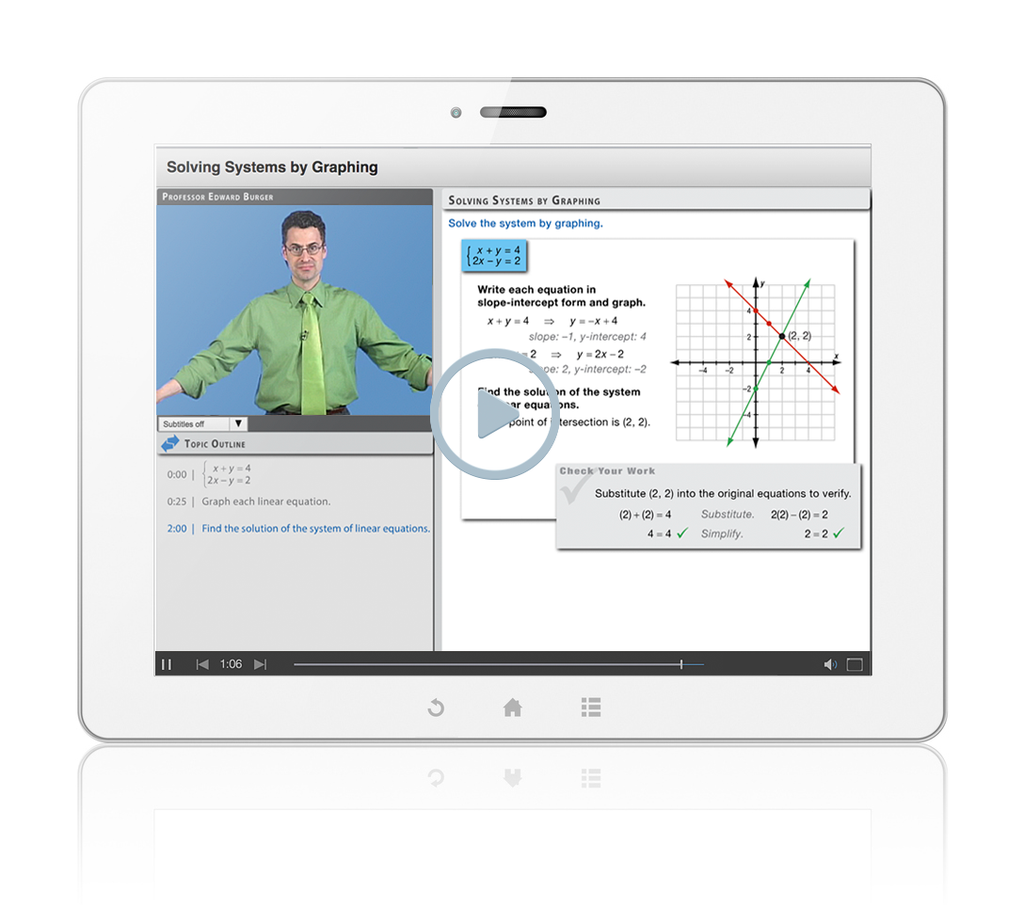
- 12-month Online Subscription to our complete Calculus course with video lessons, day-by-day lesson plans, automatically graded exercises, and much more.
- CD Set (optional) contains all of the video lessons so that you can watch them when you're away from the internet.
- Printed Notes (optional) are the Calculus course notes from the Online Subscription printed in a black & white on-the-go format.
Calculus Details
Thinkwell's Calculus covers both Calculus I and Calculus II, each of which is a one-semester course in college. Planning to take the AP Calculus AB or AP Calculus BC exam? Try our AP Calculus courses with assessments targeted to the AP exam.
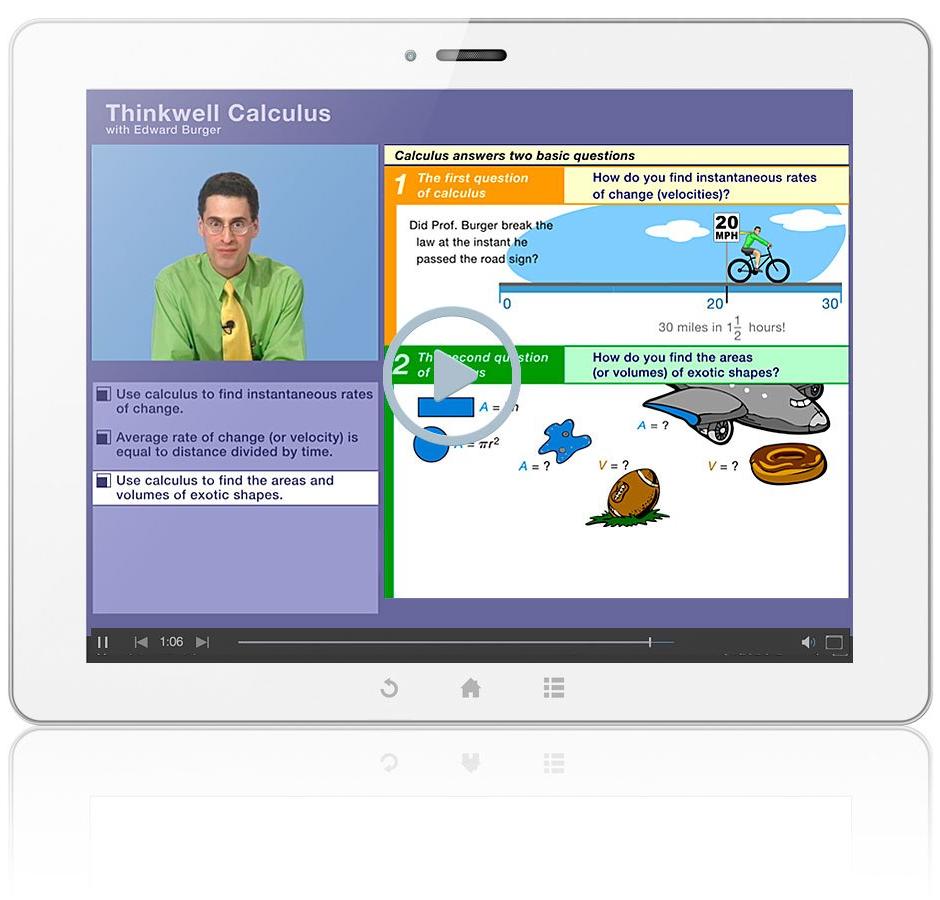
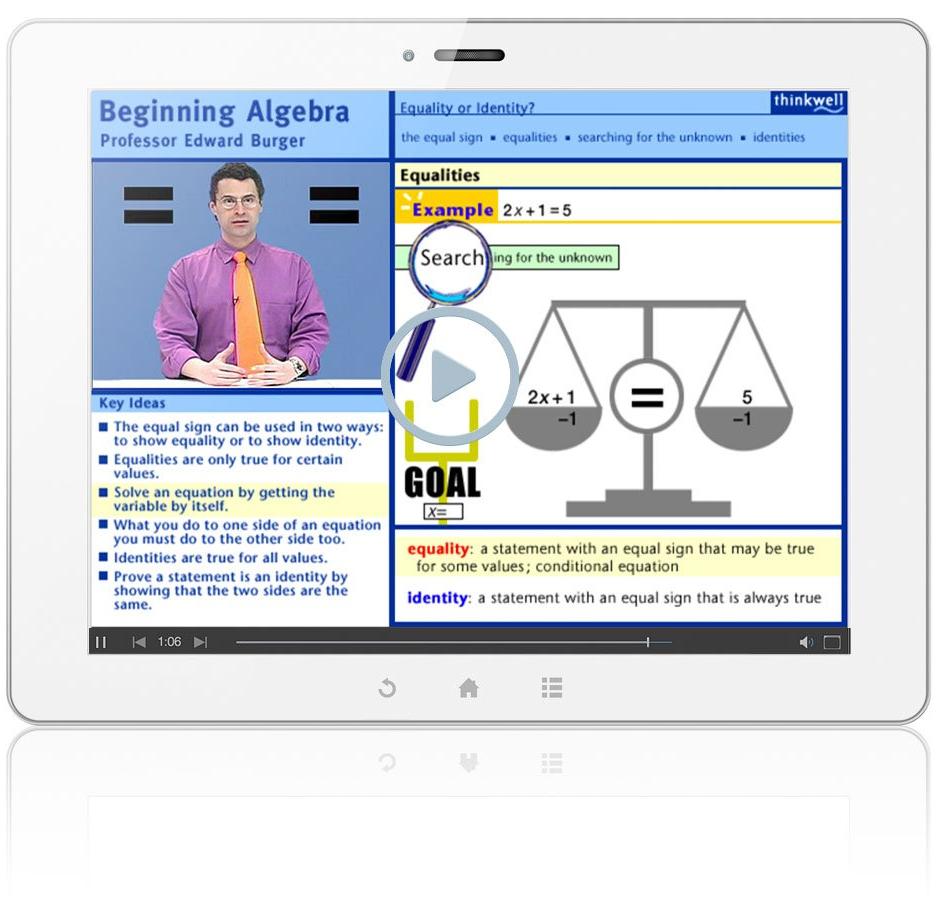
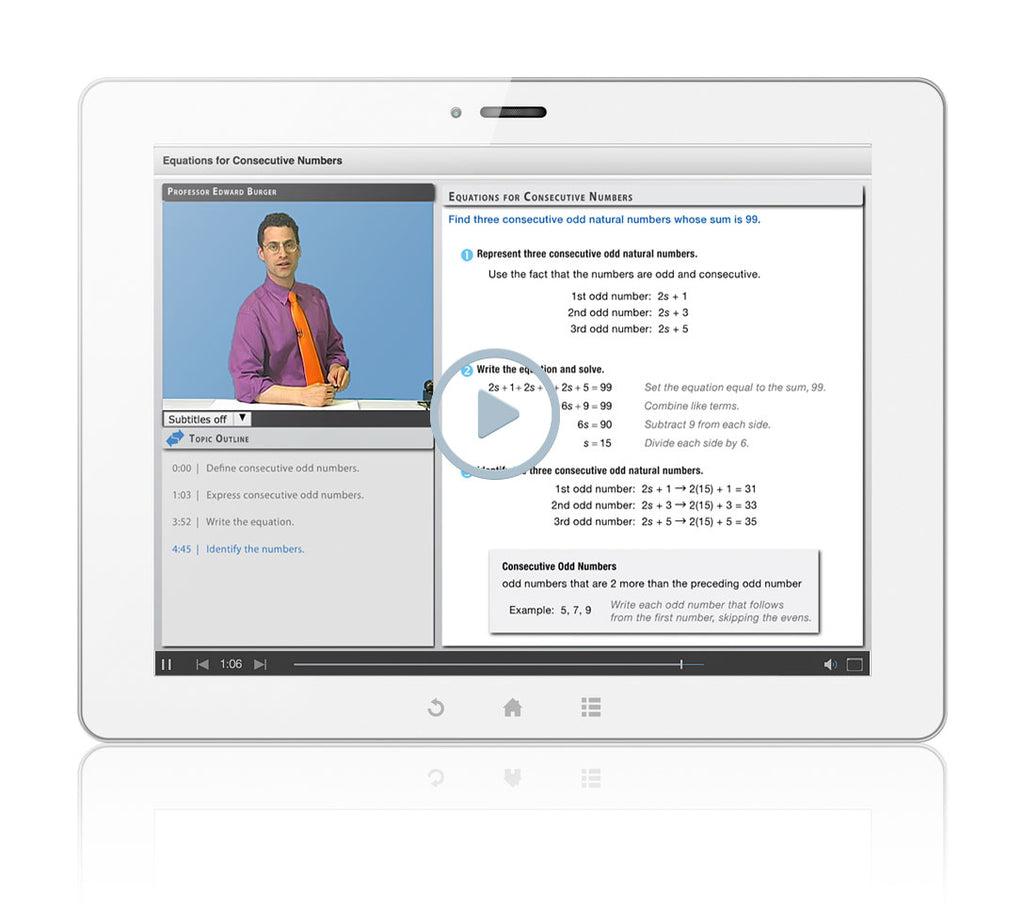
Thinkwell's award-winning math professor, Edward Burger, has a gift for explaining the underlying structure of calculus, so your students will retain what they've learned. It's a great head start for the college-bound math, science, or engineering student.
Thinkwell's Calculus has all the features your home school needs:
- More than 270 educational video lessons
- 224 available contact hours (What is this?)
The number of contact hours in a course reflects the amount of time a student will typically spend completing the assignments in each course (i.e. watching videos, doing exercises, taking exams, etc...). Many people think about contact hours as the "seat time" for a course. Thinkwell provides this information so you can ensure that the amount of instruction in a Thinkwell course meets the standards and requirements for your state or region.
- 38-week lesson plan with daily assignments (see lesson plan)
- 2000+ interactive calculus exercises with immediate feedback allow you to track your progress (See sample)
- Automatically graded calculus tests for all 21 chapters, as well as practice tests, a midterm, and a final exam
- Printable illustrated black & white notes for each topic
- Real-world application examples in both lectures and exercises
- Interactive animations with audio
- Glossary of more than 450 mathematical terms
- Engaging content to help students advance their mathematical knowledge:
- Limits and derivatives
- Computational techniques such as the power rule, product rule, quotient rule, and chain rule
- Differentiation, optimization, and related rates
- Antiderivatives, integration, and the fundamental theorem of calculus
- Indeterminate forms and L'Hopital's rule
- Sequences and series
- Differential equations
- Parametric equations and polar coordinates
- Vector calculus
About the Author
Table of Contents
(Expand All - Close All)1. The Basics
- 1.1 Overview
- 1.1.1 An Introduction to Thinkwell's Calculus
- 1.1.2 The Two Questions of Calculus
- 1.1.3 Average Rates of Change
- 1.1.4 How to Do Math
- 1.2 Precalculus Review
- 1.2.1 Functions
- 1.2.2 Graphing Lines
- 1.2.3 Parabolas
- 1.2.4 Some Non-Euclidean Geometry
2. Limits
- 2.1 The Concept of the Limit
- 2.1.1 Finding Rate of Change over an Interval
- 2.1.2 Finding Limits Graphically
- 2.1.3 The Formal Definition of a Limit
- 2.1.4 The Limit Laws, Part I
- 2.1.5 The Limit Laws, Part II
- 2.1.6 One-Sided Limits
- 2.1.7 The Squeeze Theorem
- 2.1.8 Continuity and Discontinuity
- 2.2 Evaluating Limits
- 2.2.1 Evaluating Limits
- 2.2.2 Limits and Indeterminate Forms
- 2.2.3 Two Techniques for Evaluating Limits
- 2.2.4 An Overview of Limits
3. An Introduction to Derivatives
- 3.1 Understanding the Derivative
- 3.1.1 Rates of Change, Secants, and Tangents
- 3.1.2 Finding Instantaneous Velocity
- 3.1.3 The Derivative
- 3.1.4 Differentiability
- 3.2 Using the Derivative
- 3.2.1 The Slope of a Tangent Line
- 3.2.2 Instantaneous Rate
- 3.2.3 The Equation of a Tangent Line
- 3.2.4 More on Instantaneous Rate
- 3.3 Some Special Derivatives
- 3.3.1 The Derivative of the Reciprocal Function
- 3.3.2 The Derivative of the Square Root Function
4. Computational Techniques
- 4.1 The Power Rule
- 4.1.1 A Shortcut for Finding Derivatives
- 4.1.2 A Quick Proof of the Power Rule
- 4.1.3 Uses of the Power Rule
- 4.2 The Product and Quotient Rules
- 4.2.1 The Product Rule
- 4.2.2 The Quotient Rule
- 4.3 The Chain Rule
- 4.3.1 An Introduction to the Chain Rule
- 4.3.2 Using the Chain Rule
- 4.3.3 Combining Computational Techniques
5. Special Functions
- 5.1 Trigonometric Functions
- 5.1.1 A Review of Trigonometry
- 5.1.2 Graphing Trigonometric Functions
- 5.1.3 The Derivatives of Trigonometric Functions
- 5.1.4 The Number Pi
- 5.2 Exponential Functions
- 5.2.1 Graphing Exponential Functions
- 5.2.2 Derivatives of Exponential Functions
- 5.2.3 The Music of Math
- 5.3 Logarithmic Functions
- 5.3.1 Evaluating Logarithmic Functions
- 5.3.2 The Derivative of the Natural Log Function
- 5.3.3 Using the Derivative Rules with Transcendental Functions
6. Implicit Differentiation
- 6.1 Implicit Differentiation Basics
- 6.1.1 An Introduction to Implicit Differentiation
- 6.1.2 Finding the Derivative Implicitly
- 6.2 Applying Implicit Differentiation
- 6.2.1 Using Implicit Differentiation
- 6.2.2 Applying Implicit Differentiation
7. Applications of Differentiation
- 7.1 Position and Velocity
- 7.1.1 Acceleration and the Derivative
- 7.1.2 Solving Word Problems Involving Distance and Velocity
- 7.2 Linear Approximation
- 7.2.1 Higher-Order Derivatives and Linear Approximation
- 7.2.2 Using the Tangent Line Approximation Formula
- 7.2.3 Newton's Method
- 7.3 Related Rates
- 7.3.1 The Pebble Problem
- 7.3.2 The Ladder Problem
- 7.3.3 The Baseball Problem
- 7.3.4 The Blimp Problem
- 7.3.5 Math Anxiety
- 7.4 Optimization
- 7.4.1 The Connection Between Slope and Optimization
- 7.4.2 The Fence Problem
- 7.4.3 The Box Problem
- 7.4.4 The Can Problem
- 7.4.5 The Wire-Cutting Problem
8. Curve Sketching
- 8.1 Introduction
- 8.1.1 An Introduction to Curve Sketching
- 8.1.2 Three Big Theorems
- 8.1.3 Morale Moment
- 8.2 Critical Points
- 8.2.1 Critical Points
- 8.2.2 Maximum and Minimum
- 8.2.3 Regions Where a Function Increases or Decreases
- 8.2.4 The First Derivative Test
- 8.2.5 Math Magic
- 8.3 Concavity
- 8.3.1 Concavity and Inflection Points
- 8.3.2 Using the Second Derivative to Examine Concavity
- 8.3.3 The Möbius Band
- 8.4 Graphing Using the Derivative
- 8.4.1 Graphs of Polynomial Functions
- 8.4.2 Cusp Points and the Derivative
- 8.4.3 Domain-Restricted Functions and the Derivative
- 8.4.4 The Second Derivative Test
- 8.5 Asymptotes
- 8.5.1 Vertical Asymptotes
- 8.5.2 Horizontal Asymptotes and Infinite Limits
- 8.5.3 Graphing Functions with Asymptotes
- 8.5.4 Functions with Asymptotes and Holes
- 8.5.5 Functions with Asymptotes and Critical Points
9. The Basics of Integration
- 9.1 Antiderivatives
- 9.1.1 Antidifferentiation
- 9.1.2 Antiderivatives of Powers of x
- 9.1.3 Antiderivatives of Trigonometric and Exponential Functions
- 9.2 Integration by Substitution
- 9.2.1 Undoing the Chain Rule
- 9.2.2 Integrating Polynomials by Substitution
- 9.3 Illustrating Integration by Substitution
- 9.3.1 Integrating Composite Trigonometric Functions by Substitution
- 9.3.2 Integrating Composite Exponential and Rational Functions by Substitution
- 9.3.3 More Integrating Trigonometric Functions by Substitution
- 9.3.4 Choosing Effective Function Decompositions
- 9.4 The Fundamental Theorem of Calculus
- 9.4.1 Approximating Areas of Plane Regions
- 9.4.2 Areas, Riemann Sums, and Definite Integrals
- 9.4.3 The Fundamental Theorem of Calculus, Part I
- 9.4.4 The Fundamental Theorem of Calculus, Part II
- 9.4.5 Illustrating the Fundamental Theorem of Calculus
- 9.4.6 Evaluating Definite Integrals
10. Applications of Integration
- 10.1 Motion
- 10.1.1 Antiderivatives and Motion
- 10.1.2 Gravity and Vertical Motion
- 10.1.3 Solving Vertical Motion Problems
- 10.2 Finding the Area between Two Curves
- 10.2.1 The Area between Two Curves
- 10.2.2 Limits of Integration and Area
- 10.2.3 Common Mistakes to Avoid When Finding Areas
- 10.2.4 Regions Bound by Several Curves
- 10.3 Integrating with Respect to y
- 10.3.1 Finding Areas by Integrating with Respect to y: Part One
- 10.3.2 Finding Areas by Integrating with Respect to y: Part Two
- 10.3.3 Area, Integration by Substitution, and Trigonometry
11. Calculus I Review
- 11.1 The Close of Calculus I
- 11.1.1 A Glimpse Into Calculus II
12. Math Fun
- 12.1 Paradoxes
- 12.1.1 An Introduction to Paradoxes
- 12.1.2 Paradoxes and Air Safety
- 12.1.3 Newcomb's Paradox
- 12.1.4 Zeno's Paradox
- 12.2 Sequences
- 12.2.1 Fibonacci Numbers
- 12.2.2 The Golden Ratio
13. An Introduction to Calculus II
- 13.1 Introduction
- 13.1.1 Welcome to Calculus II
- 13.1.2 Review: Calculus I in 20 Minutes
14. L'Hôpital's Rule
- 14.1 Indeterminate Quotients
- 14.1.1 Indeterminate Forms
- 14.1.2 An Introduction to L'Hôpital's Rule
- 14.1.3 Basic Uses of L'Hôpital's Rule
- 14.1.4 More Exotic Examples of Indeterminate Forms
- 14.2 Other Indeterminate Forms
- 14.2.1 L'Hôpital's Rule and Indeterminate Products
- 14.2.2 L'Hôpital's Rule and Indeterminate Differences
- 14.2.3 L'Hôpital's Rule and One to the Infinite Power
- 14.2.4 Another Example of One to the Infinite Power
15. Elementary Functions and Their Inverses
- 15.1 Inverse Functions
- 15.1.1 The Exponential and Natural Log Functions
- 15.1.2 Differentiating Logarithmic Functions
- 15.1.3 Logarithmic Differentiation
- 15.1.4 The Basics of Inverse Functions
- 15.1.5 Finding the Inverse of a Function
- 15.2 The Calculus of Inverse Functions
- 15.2.1 Derivatives of Inverse Functions
- 15.3 Inverse Trigonometric Functions
- 15.3.1 The Inverse Sine, Cosine, and Tangent Functions
- 15.3.2 The Inverse Secant, Cosecant, and Cotangent Functions
- 15.3.3 Evaluating Inverse Trigonometric Functions
- 15.4 The Calculus of Inverse Trigonometric Functions
- 15.4.1 Derivatives of Inverse Trigonometric Functions
- 15.4.2 More Calculus of Inverse Trigonometric Functions
- 15.5 The Hyperbolic Functions
- 15.5.1 Defining the Hyperbolic Functions
- 15.5.2 Hyperbolic Identities
- 15.5.3 Derivatives of Hyperbolic Functions
16. Techniques of Integration
- 16.1 Integration Using Tables
- 16.1.1 An Introduction to the Integral Table
- 16.1.2 Making u-Substitutions
- 16.2 Integrals Involving Powers of Sine and Cosine
- 16.2.1 An Introduction to Integrals with Powers of Sine and Cosine
- 16.2.2 Integrals with Powers of Sine and Cosine
- 16.2.3 Integrals with Even and Odd Powers of Sine and Cosine
- 16.3 Integrals Involving Powers of Other Trigonometric Functions
- 16.3.1 Integrals of Other Trigonometric Functions
- 16.3.2 Integrals with Odd Powers of Tangent and Any Power of Secant
- 16.3.3 Integrals with Even Powers of Secant and Any Power of Tangent
- 16.4 An Introduction to Integration by Partial Fractions
- 16.4.1 Finding Partial Fraction Decompositions
- 16.4.2 Partial Fractions
- 16.4.3 Long Division
- 16.5 Integration by Partial Fractions with Repeated Factors
- 16.5.1 Repeated Linear Factors: Part One
- 16.5.2 Repeated Linear Factors: Part Two
- 16.5.3 Distinct and Repeated Quadratic Factors
- 16.5.4 Partial Fractions of Transcendental Functions
- 16.6 Integration by Parts
- 16.6.1 An Introduction to Integration by Parts
- 16.6.2 Applying Integration by Parts to the Natural Log Function
- 16.6.3 Inspirational Examples of Integration by Parts
- 16.6.4 Repeated Application of Integration by Parts
- 16.6.5 Algebraic Manipulation and Integration by Parts
- 16.7 An Introduction to Trigonometric Substitution
- 16.7.1 Converting Radicals into Trigonometric Expressions
- 16.7.2 Using Trigonometric Substitution to Integrate Radicals
- 16.7.3 Trigonometric Substitutions on Rational Powers
- 16.8 Trigonometric Substitution Strategy
- 16.8.1 An Overview of Trigonometric Substitution Strategy
- 16.8.2 Trigonometric Substitution Involving a Definite Integral: Part One
- 16.8.3 Trigonometric Substitution Involving a Definite Integral: Part Two
- 16.9 Numerical Integration
- 16.9.1 Deriving the Trapezoidal Rule
- 16.9.2 An Example of the Trapezoidal Rule
17. Improper Integrals
- 17.1 Improper Integrals
- 17.1.1 The First Type of Improper Integral
- 17.1.2 The Second Type of Improper Integral
- 17.1.3 Infinite Limits of Integration, Convergence, and Divergence
18. Applications of Integral Calculus
- 18.1 The Average Value of a Function
- 18.1.1 Finding the Average Value of a Function
- 18.2 Finding Volumes Using Cross-Sections
- 18.2.1 Finding Volumes Using Cross-Sectional Slices
- 18.2.2 An Example of Finding Cross-Sectional Volumes
- 18.3 Disks and Washers
- 18.3.1 Solids of Revolution
- 18.3.2 The Disk Method along the y-Axis
- 18.3.3 A Transcendental Example of the Disk Method
- 18.3.4 The Washer Method across the x-Axis
- 18.3.5 The Washer Method across the y-Axis
- 18.4 Shells
- 18.4.1 Introducing the Shell Method
- 18.4.2 Why Shells Can Be Better Than Washers
- 18.4.3 The Shell Method: Integrating with Respect to y
- 18.5 Arc Lengths and Functions
- 18.5.1 An Introduction to Arc Length
- 18.5.2 Finding Arc Lengths of Curves Given by Functions
- 18.6 Work
- 18.6.1 An Introduction to Work
- 18.6.2 Calculating Work
- 18.6.3 Hooke's Law
- 18.7 Moments and Centers of Mass
- 18.7.1 Center of Mass
- 18.7.2 The Center of Mass of a Thin Plate
19. Sequences and Series
- 19.1 Sequences
- 19.1.1 The Limit of a Sequence
- 19.1.2 Determining the Limit of a Sequence
- 19.1.3 The Squeeze and Absolute Value Theorems
- 19.2 Monotonic and Bounded Sequences
- 19.2.1 Monotonic and Bounded Sequences
- 19.3 Infinite Series
- 19.3.1 An Introduction to Infinite Series
- 19.3.2 The Summation of Infinite Series
- 19.3.3 Geometric Series
- 19.3.4 Telescoping Series
- 19.4 Convergence and Divergence
- 19.4.1 Properties of Convergent Series
- 19.4.2 The nth-Term Test for Divergence
- 19.5 The Integral Test
- 19.5.1 An Introduction to the Integral Test
- 19.5.2 Examples of the Integral Test
- 19.5.3 Using the Integral Test
- 19.5.4 Defining p-Series
- 19.6 The Direct Comparison Test
- 19.6.1 An Introduction to the Direct Comparison Test
- 19.6.2 Using the Direct Comparison Test
- 19.7 The Limit Comparison Test
- 19.7.1 An Introduction to the Limit Comparison Test
- 19.7.2 Using the Limit Comparison Test
- 19.7.3 Inverting the Series in the Limit Comparison Test
- 19.8 The Alternating Series
- 19.8.1 Alternating Series
- 19.8.2 The Alternating Series Test
- 19.8.3 Estimating the Sum of an Alternating Series
- 19.9 Absolute and Conditional Convergences
- 19.9.1 Absolute and Conditional Convergence
- 19.10 The Ratio and Root Tests
- 19.10.1 The Ratio Test
- 19.10.2 Examples of the Ratio Test
- 19.10.3 The Root Test
- 19.11 Polynomial Approximations of Elementary Functions
- 19.11.1 Polynomial Approximation of Elementary Functions
- 19.11.2 Higher-Degree Approximations
- 19.12 Taylor and Maclaurin Polynomials
- 19.12.1 Taylor Polynomials
- 19.12.2 Maclaurin Polynomials
- 19.12.3 The Remainder of a Taylor Polynomial
- 19.12.4 Approximating the Value of a Function
- 19.13 Taylor and Maclaurin Series
- 19.13.1 Taylor Series
- 19.13.2 Examples of the Taylor and Maclaurin Series
- 19.13.3 New Taylor Series
- 19.13.4 The Convergence of Taylor Series
- 19.14 Power Series
- 19.14.1 The Definition of Power Series
- 19.14.2 The Interval and Radius of Convergence
- 19.14.3 Finding the Interval and Radius of Convergence: Part One
- 19.14.4 Finding the Interval and Radius of Convergence: Part Two
- 19.14.5 Finding the Interval and Radius of Convergence: Part Three
- 19.15 Power Series Representations of Functions
- 19.15.1 Differentiation and Integration of Power Series
- 19.15.2 Finding Power Series Representations by Differentiation
- 19.15.3 Finding Power Series Representations by Integration
- 19.15.4 Integrating Functions Using Power Series

20. Differential Equations
- 20.1 Separable Differential Equations
- 20.1.1 An Introduction to Differential Equations
- 20.1.2 Solving Separable Differential Equations
- 20.1.3 Finding a Particular Solution
- 20.1.4 Direction Fields
- 20.2 Solving a Homogeneous Differential Equation
- 20.2.1 Separating Homogeneous Differential Equations
- 20.2.2 Change of Variables
- 20.3 Growth and Decay Problems
- 20.3.1 Exponential Growth
- 20.3.2 Radioactive Decay
- 20.4 Solving First-Order Linear Differential Equations
- 20.4.1 First-Order Linear Differential Equations
- 20.4.2 Using Integrating Factors
21. Parametric Equations and Polar Coordinates
- 21.1 Understanding Parametric Equations
- 21.1.1 An Introduction to Parametric Equations
- 21.1.2 The Cycloid
- 21.1.3 Eliminating Parameters
- 21.2 Calculus and Parametric Equations
- 21.2.1 Derivatives of Parametric Equations
- 21.2.2 Graphing the Elliptic Curve
- 21.2.3 The Arc Length of a Parameterized Curve
- 21.2.4 Finding Arc Lengths of Curves Given by Parametric Equations
- 21.3 Understanding Polar Coordinates
- 21.3.1 The Polar Coordinate System
- 21.3.2 Converting between Polar and Cartesian Forms
- 21.3.3 Spirals and Circles
- 21.3.4 Graphing Some Special Polar Functions
- 21.4 Polar Functions and Slope
- 21.4.1 Calculus and the Rose Curve
- 21.4.2 Finding the Slopes of Tangent Lines in Polar Form
- 21.5 Polar Functions and Area
- 21.5.1 Heading toward the Area of a Polar Region
- 21.5.2 Finding the Area of a Polar Region: Part One
- 21.5.3 Finding the Area of a Polar Region: Part Two
- 21.5.4 The Area of a Region Bounded by Two Polar Curves: Part One
- 21.5.5 The Area of a Region Bounded by Two Polar Curves: Part Two
22. Vector Calculus and the Geometry of R2 and R3
- 22.1 Vectors and the Geometry of R2 and R3
- 22.1.1 Coordinate Geometry in Three Dimensional Space
- 22.1.2 Introduction to Vectors
- 22.1.3 Vectors in R2 and R3
- 22.1.4 An Introduction to the Dot Product
- 22.1.5 Orthogonal Projections
- 22.1.6 An Introduction to the Cross Product
- 22.1.7 Geometry of the Cross Product
- 22.1.8 Equations of Lines and Planes in R3
- 22.2 Vector Functions
- 22.2.1 Introduction to Vector Functions
- 22.2.2 Derivatives of Vector Functions
- 22.2.3 Vector Functions: Smooth Curves
- 22.2.4 Vector Functions: Velocity and Acceleration