Algebra 1
- 12-month Online Subscription to our complete Algebra 1 course with video lessons, day-by-day lesson plans, automatically graded exercises, and much more.
- CD Set (optional) contains all of the video lessons so that you can watch them when you're away from the internet.
Algebra 1 Details
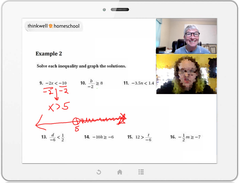
Thinkwell's Algebra 1 course has online videos and automatic grading that teach algebra the way today’s students want to learn it. Whether you need a complete course or algebra homework help, Algebra 1 has everything you need.
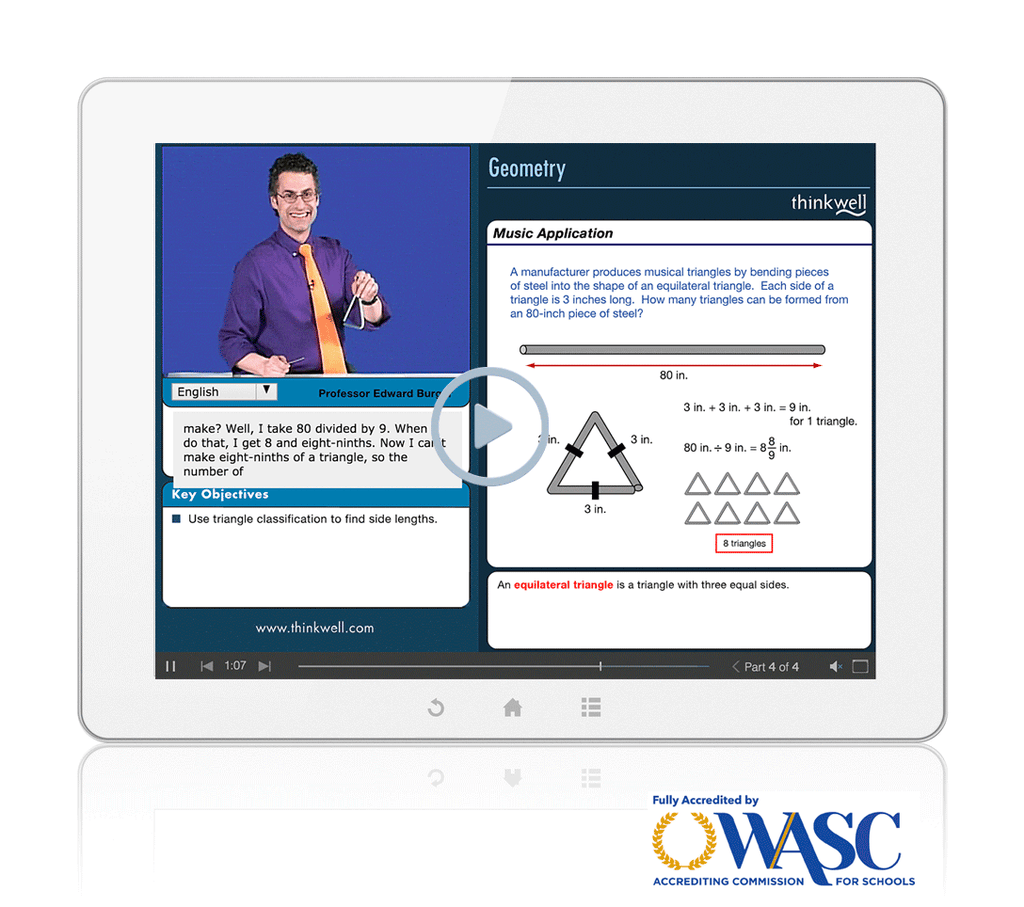
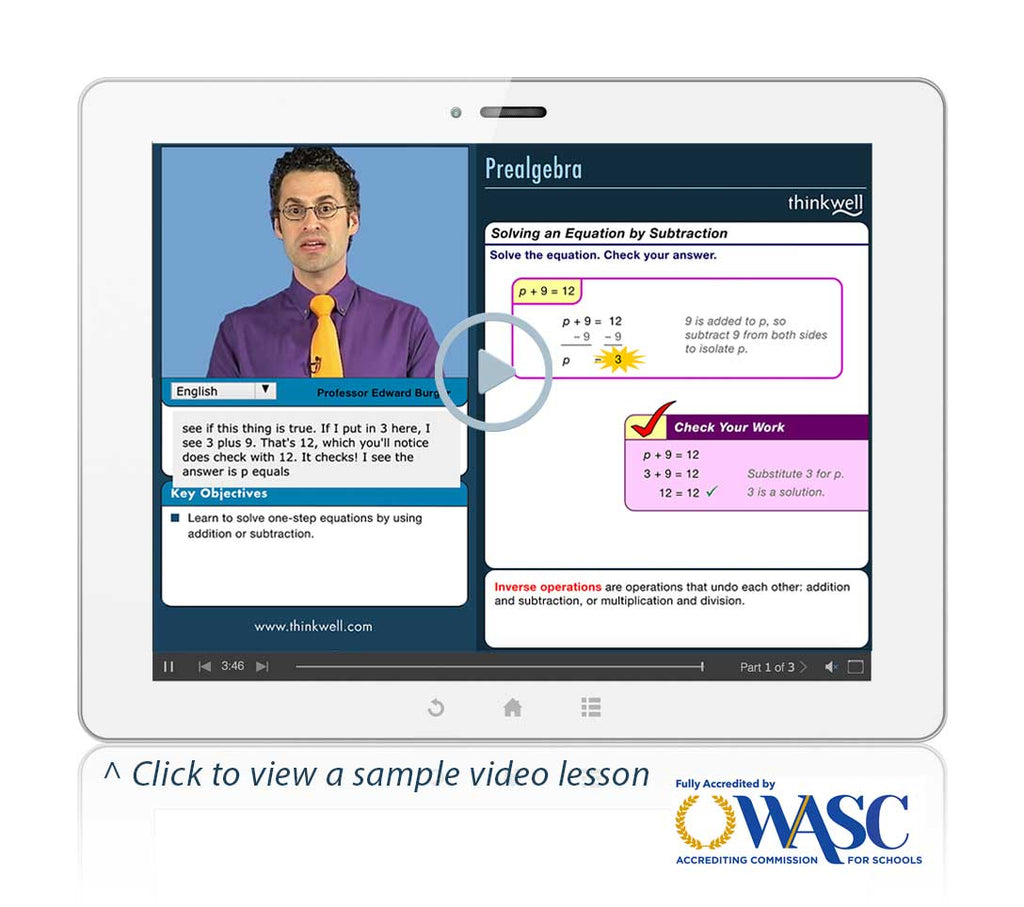
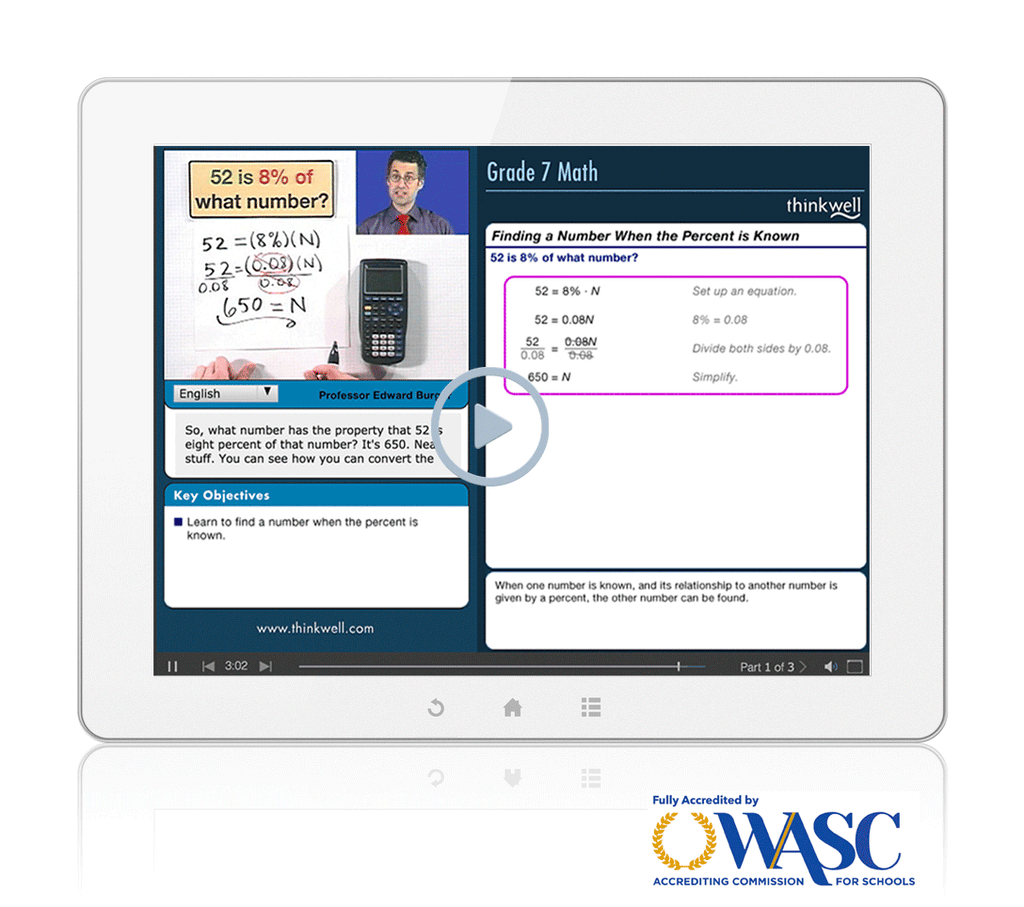
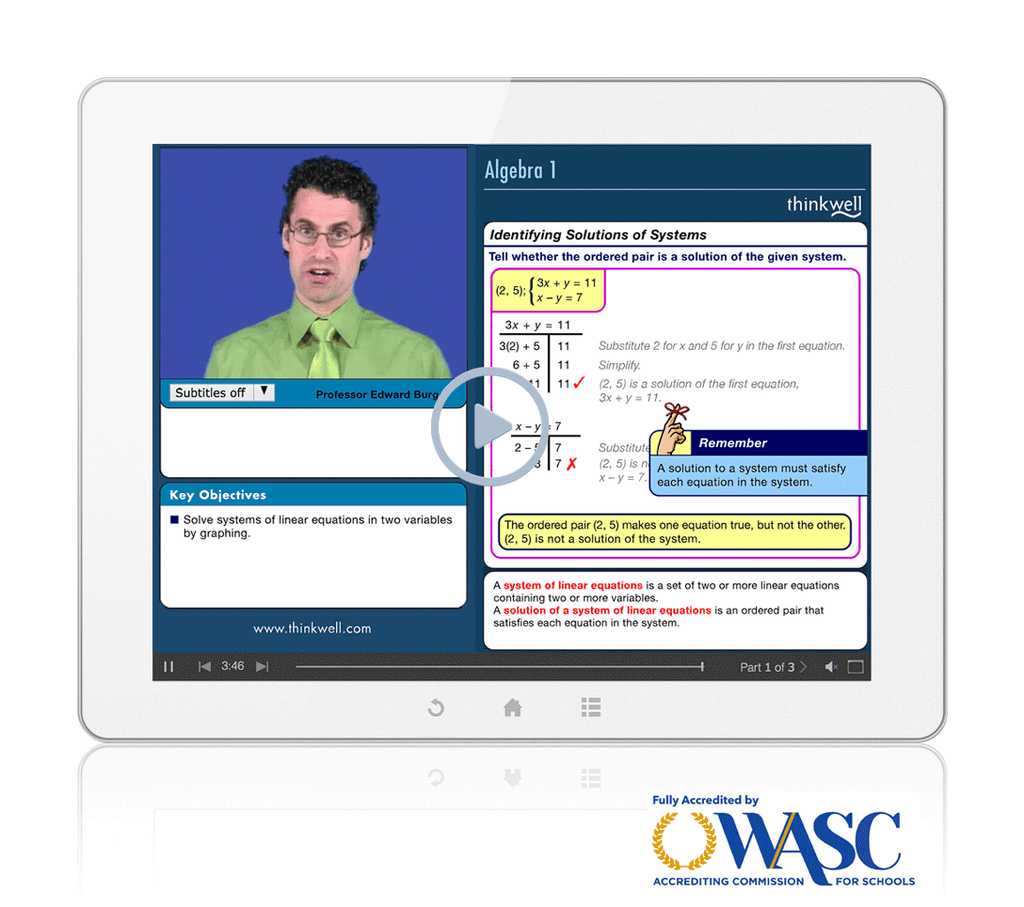
Students enjoy our online video lessons with award-winning teacher Edward Burger; he's smart and funny, and his multimedia lessons work with any learning style. His step-by-step lessons focus on examples and real-world applications, which makes learning algebra fun and easy.
Thinkwell's Algebra 1 has all the features your home school needs:
- Aligned to Algebra 1 National Math Standards
- 34-week lesson plan with daily assignments (see lesson plan)
- More than 95 topics with 250+ engaging video lessons (see sample)
- 100 available contact hours (What is this?)
The number of contact hours in a course reflects the amount of time a student will typically spend completing the assignments in each course (i.e. watching videos, doing exercises, taking exams, etc...). Many people think about contact hours as the "seat time" for a course. Thinkwell provides this information so you can ensure that the amount of instruction in a Thinkwell course meets the standards and requirements for your state or region.
- Printable Algebra 1 worksheets and answer keys for each subchapter and topic
(See sample worksheet - See sample answer key) - 1000+ automatically graded exercises allow you to track your progress
- 23 animated interactivities with audio
- Algebra practice tests and final tests for all 12 chapters, as well as a midterm and a final
- Real-world application examples in both lectures and exercises
- Closed captioning for all video lessons (most are also available in Spanish)
- Glossary of more than 200 mathematical terms
- Brand-new content to help students advance their mathematical knowledge:
- Foundations for algebra
- Equations, proportions, and percent
- Inequalities
- Functions
- Linear functions
- Systems of equations and inequalities
- Exponents and polynomials
- Factoring polynomials
- Quadratic functions and equations
- Data analysis and probability
- Exponential and radical functions
- Rational functions and equations
About the Author
Table of Contents
(Expand All - Close All)1. Foundations for Algebra
- 1.1 The Language of Algebra
- 1.1.1 Variables and Expressions
- 1.1.2 Adding and Subtracting Real Numbers
- 1.1.3 Multiplying and Dividing Real Numbers
- 1.1.4 Powers and Exponents
- 1.1.5 Square Roots and Real Numbers
- 1.2 Tools of Algebra
- 1.2.1 Set Theory
- 1.2.2 Order of Operations
- 1.2.3 Simplifying Expressions
- 1.2.4 Introduction to Functions
2. Equations, Proportions, and Percent
- 2.1 Solving Equations
- 2.1.1 Addition and Subtraction Equations
- 2.1.2 Multiplication and Division Equations
- 2.1.3 Solving Two-Step Equations
- 2.1.4 Solving Multi-Step Equations
- 2.1.5 Solving Equations with Variables on Both Sides
- 2.1.6 Solving Literal Equations
- 2.1.7 Solving Absolute-Value Equations
- 2.2 Proportion and Percent
- 2.2.1 Rates, Ratios, and Proportions
- 2.2.2 Applications of Proportion
- 2.2.3 Percents
- 2.2.4 Applications of Percent
- 2.2.5 Percent Increase and Decrease
3. Inequalities
- 3.1 Introduction to Inequalities
- 3.1.1 Graphing and Writing Inequalities
- 3.1.2 Solving Inequalities by Adding or Subtracting
- 3.1.3 Solving Inequalities by Multiplying or Dividing
- 3.2 Multi-Step and Compound Inequalities
- 3.2.1 Solving Two-Step and Multi-Step Inequalities
- 3.2.2 Solving Inequalities with Variables on Both Sides
- 3.2.3 Solving Compound Inequalities
- 3.2.4 Solving Absolute-Value Inequalities
4. Functions
- 4.1 Introduction to Functions
- 4.1.1 Graphing Relationships
- 4.1.2 Relations and Functions
- 4.1.3 Writing Function Rules
- 4.2 Applying Functions
- 4.2.1 Graphing Functions
- 4.2.2 Scatter Plots and Trend Lines
- 4.2.3 Arithmetic Sequences
5. Linear Functions
- 5.1 Characteristics of Linear Functions
- 5.1.1 Identifying Linear Functions
- 5.1.2 Using Intercepts
- 5.1.3 Rate of Change and Slope
- 5.1.4 The Slope Formula
- 5.1.5 The Midpoint and Distance Formulas
- 5.1.6 Direct Variation
- 5.2 Using Linear Functions
- 5.2.1 Slope-Intercept Form
- 5.2.2 Point-Slope Form
- 5.2.3 Slopes of Parallel and Perpendicular Lines
- 5.2.4 Transforming Linear Functions
6. Systems of Equations and Inequalities
- 6.1 Systems of Linear Equations
- 6.1.1 Solving Systems by Graphing
- 6.1.2 Solving Systems by Substitution
- 6.1.3 Solving Systems by Elimination
- 6.1.4 Solving Special Systems
- 6.1.5 Applying Systems
- 6.2 Linear Inequalities
- 6.2.1 Graphing Linear Inequalities
- 6.2.2 Solving Systems of Linear Inequalities
7. Exponents and Polynomials
- 7.1 Exponents
- 7.1.1 Product and Power Properties of Exponents
- 7.1.2 Integer Exponents
- 7.1.3 Quotient Properties of Exponents
- 7.1.4 An Application of Exponents: Scientific Notation
- 7.1.5 Fractional Exponents
- 7.2 Polynomials
- 7.2.1 Polynomials
- 7.2.2 Adding and Subtracting Polynomials
- 7.2.3 Multiplying Polynomials by Monomials
- 7.2.4 Multiplying Binomials
8. Factoring Polynomials
- 8.1 Factoring Methods
- 8.1.1 Factors and Greatest Common Factors
- 8.1.2 Factoring by GCF
- 8.1.3 Factoring x2 + bx + c
- 8.1.4 Factoring ax2 + bx + c
- 8.2 Applying Factoring Methods
- 8.2.1 Factoring Special Products
- 8.2.2 Choosing a Factoring Method
9. Quadratic Functions and Equations
- 9.1 Quadratic Functions
- 9.1.1 Identifying Quadratic Functions
- 9.1.2 Characteristics of Quadratic Functions
- 9.1.3 Graphing Quadratic Functions
- 9.1.4 Transforming Quadratic Functions
- 9.2 Solving Quadratic Equations
- 9.2.1 Solving Quadratic Equations by Graphing
- 9.2.2 Solving Quadratic Equations by Factoring
- 9.2.3 Solving Quadratic Equations by Using Square Roots
- 9.2.4 Completing the Square
- 9.2.5 The Quadratic Formula
- 9.2.6 The Discriminant
10. Data Analysis and Probability
- 10.1 Probability
- 10.1.1 Experimental Probability
- 10.1.2 Theoretical Probability
- 10.1.3 Independent and Dependent Events
- 10.1.4 Combinations and Permutations
- 10.2 Data Analysis
- 10.2.1 Bar, Circle, and Line Graphs
- 10.2.2 Stem and Leaf Plots and Histograms
- 10.2.3 Mean, Median, Mode, and Range
- 10.2.4 Box-and-Whisker Plots
- 10.2.5 Expected Value
- 10.2.6 Normal Distribution
- 10.2.7 Misleading Graphs and Statistics
11. Exponential and Radical Functions
- 11.1 Exponential Functions
- 11.1.1 Geometric Sequences
- 11.1.2 Exponential Functions
- 11.1.3 Exponential Growth and Decay
- 11.1.4 Linear, Quadratic, and Exponential Models
- 11.2 Radical Functions, Expressions, and Equations
- 11.2.1 Square-Root Functions
- 11.2.2 Radical Expressions
- 11.2.3 Adding and Subtracting Radical Expressions
- 11.2.4 Multiplying and Dividing Radical Expressions
- 11.2.5 Solving Radical Equations
12. Rational Functions and Equations
- 12.1 Rational Functions and Expressions
- 12.1.1 Inverse Variation
- 12.1.2 Rational Functions
- 12.1.3 Simplifying Rational Expressions
- 12.2 Operations with Rational Expressions
- 12.2.1 Multiplying and Dividing Rational Expressions
- 12.2.2 Adding and Subtracting Rational Expressions
- 12.2.3 Dividing Polynomials
- 12.2.4 Solving Rational Equations