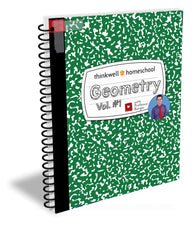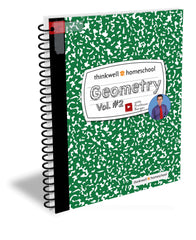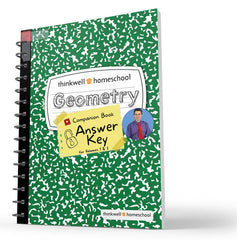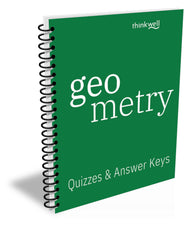
Geometry
- 12-month Online Subscription to our complete Geometry course with video lessons, day-by-day lesson plans, automatically graded exercises, and much more.
Geometry Details
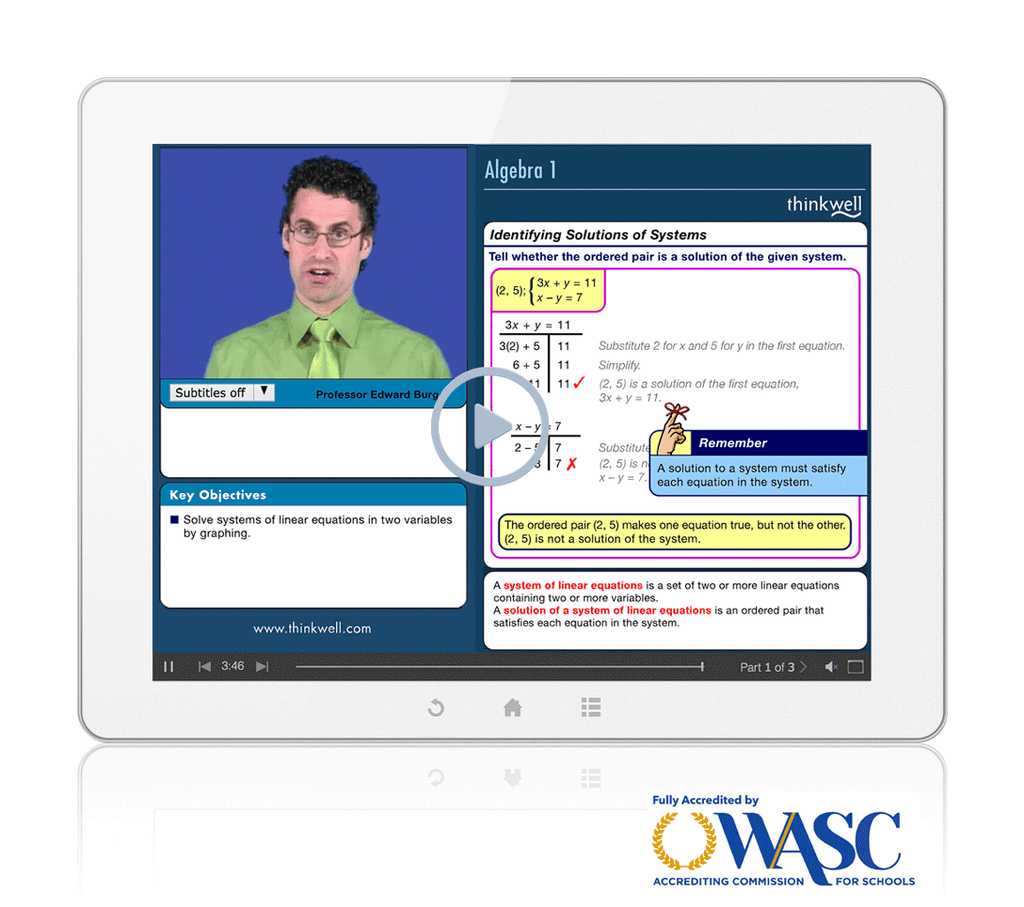
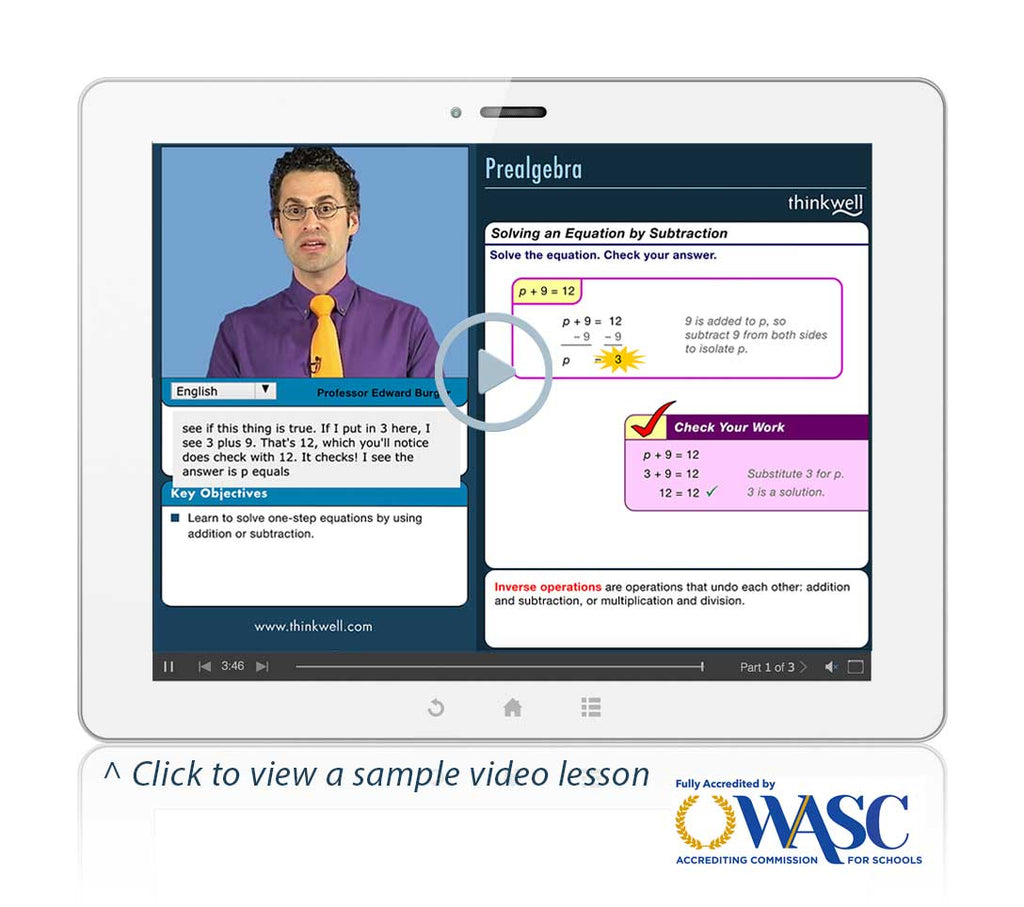
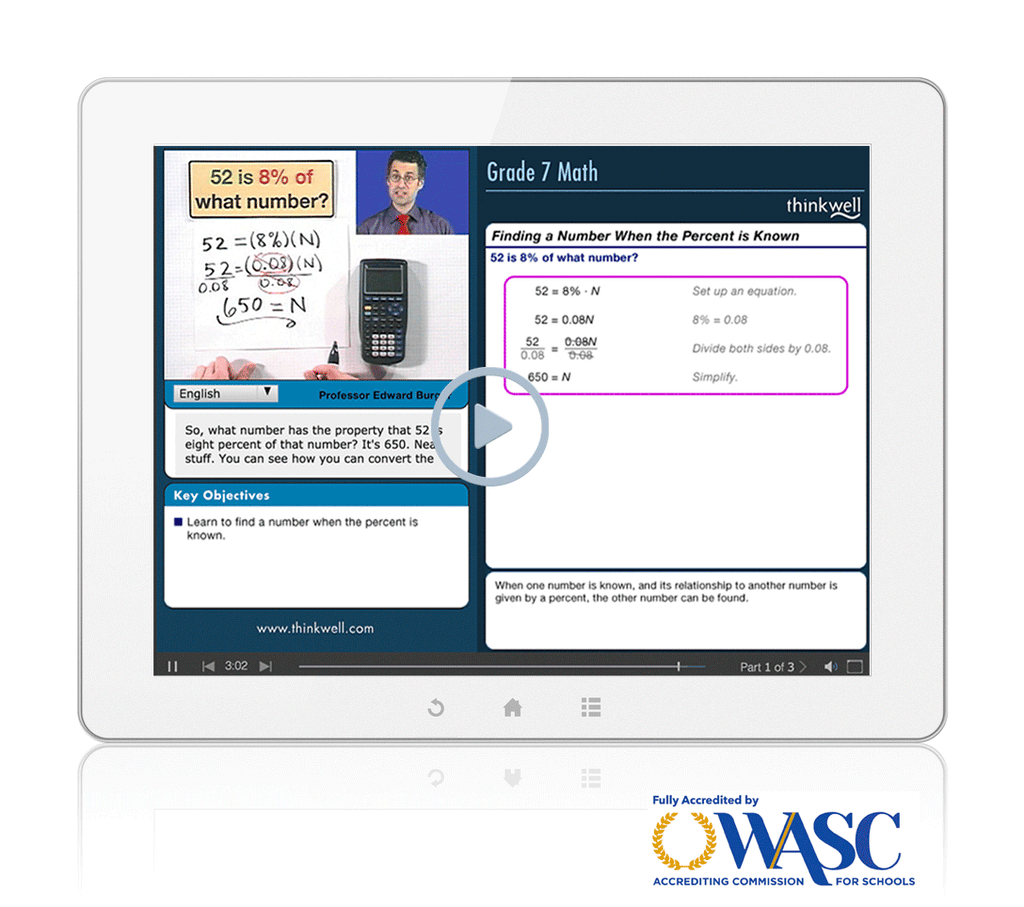
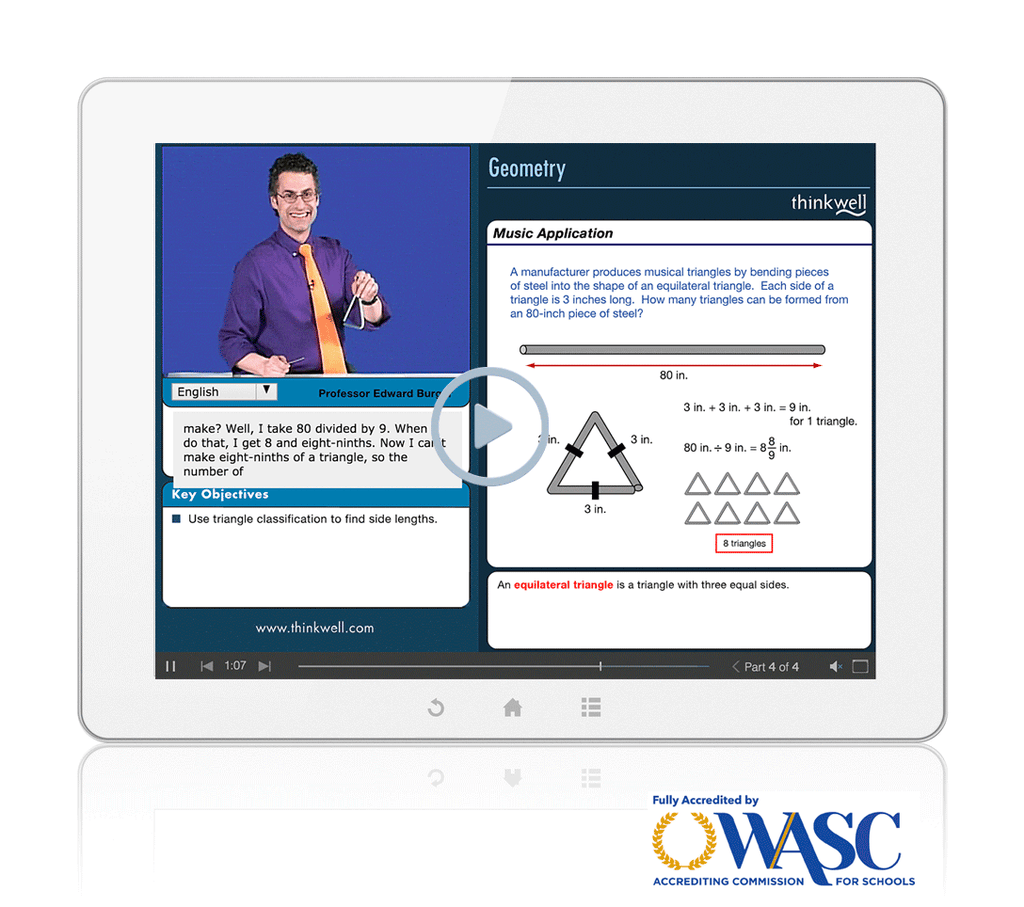
Thinkwell's Geometry course contains all of the geometry help your homeschool student needs. This complete online Geometry course is fun and easy to use; our enjoyable and effective multimedia videos are the heart of the course. After watching a geometry video lesson, your students will review and practice with automatically graded exercises that give you an instant way to assess their progress, as well as with printable geometry worksheets with answer keys.
Our videos feature award-winning teacher Edward Burger, whose multimedia video lessons have been created to work with any learning style. The course includes automatically graded exercises and tests, geometry practice worksheets, a geometry glossary (geometry dictionary) of geometry terms, at-a-glance grades and progress review, and our fun and interesting animated Interactivities.
Thinkwell's Geometry has all the features your home school needs:
- Aligned to Geometry National Math Standards
- More than 100 topics with 400+ engaging video lessons
- 34-week lesson plan with daily assignments (see lesson plan)
- 101.6 available contact hours (What is this?)
The number of contact hours in a course reflects the amount of time a student will typically spend completing the assignments in each course (i.e. watching videos, doing exercises, taking exams, etc...). Many people think about contact hours as the "seat time" for a course. Thinkwell provides this information so you can ensure that the amount of instruction in a Thinkwell course meets the standards and requirements for your state or region.
- 1300+ automatically graded exercises allow you to track your progress
- 24 animated interactivities with audio
- Printable geometry worksheets and answer keys for each subchapter and topic
(See sample worksheet - See sample answer key) - Geometry tests, including 13 chapter tests, as well as practice tests, a midterm, and a final exam
- Printable illustrated notes for each topic
- Real-world application examples in both lectures and exercises
- Closed captioning for all video lessons
- Glossary of more than 250 mathematical terms
- Review of essential algebra concepts and applications
- Brand new content to help students advance their mathematical knowledge:
- measuring and constructing segments and angles
- using inductive and deductive reasoning
- mathematical proofs
- parallel and perpendicular lines
- triangle congruence: SSS, SAS, ASA, AAS, HL, and CPCTC
- medians, altitudes, and midsegments in triangles
- the Pythagorean theorem
- properties and attributes of polygons and quadrilaterals
- similarity relationships
- trigonometric ratios
- perimeter, circumference, and area of two-dimensional shapes
About the Author
Table of Contents
(Expand All - Close All)1. Fundamentals of Geometry
- 1.1 Points, Lines, Planes, and Angles
- 1.1.1 Understanding Points, Lines, and Planes
- 1.1.2 Measuring and Constructing Segments
- 1.1.3 Measuring and Constructing Angles
- 1.1.4 Pairs of Angles
- 1.2 Coordinate and Transformation Tools
- 1.2.1 Using Formulas in Geometry
- 1.2.2 Midpoint and Distance in the Coordinate Plane
- 1.2.3 Transformations in the Coordinate Plane
2. Reasoning and Writing Geometric Proofs
- 2.1 Inductive and Deductive Reasoning
- 2.1.1 Using Inductive Reasoning to Make Conjectures
- 2.1.2 Conditional Statements
- 2.1.3 Using Deductive Reasoning to Verify Conjectures
- 2.1.4 Biconditional Statements and Definitions
- 2.2 Mathematical Proof
- 2.2.1 Algebraic Proof
- 2.2.2 Geometric Proof
- 2.2.3 Flowchart and Paragraph Proofs
3. Parallel and Perpendicular Lines
- 3.1 Lines with Transversals
- 3.1.1 Planes, Lines, and Angles
- 3.1.2 Angles, Parallel Lines, and Transversals
- 3.1.3 Proving that Lines are Parallel
- 3.1.4 Properties of Perpendicular Lines
- 3.2 Slope and the Equation of a Line
- 3.2.1 Finding the Slope Given Two Points
- 3.2.2 Slope-Intercept Form
- 3.2.3 Point-Slope Form
- 3.2.4 Slopes of Parallel and Perpendicular Lines
4. Triangle Congruence
- 4.1 Triangles and Congruence
- 4.1.1 Classifying Triangles
- 4.1.2 Angle Relationships in Triangles
- 4.1.3 Congruent Triangles
- 4.2 Proving Triangle Congruence
- 4.2.1 Triangle Congruence: SSS and SAS
- 4.2.2 Triangle Congruence: ASA, AAS, and HL
- 4.2.3 Triangle Congruence: CPCTC
- 4.2.4 Introduction to Coordinate Proof
- 4.2.5 Isosceles and Equilateral Triangles
5. Properties and Attributes of Triangles
- 5.1 Segments in Triangles
- 5.1.1 Perpendicular and Angle Bisector Theorems
- 5.1.2 Medians, Altitudes, and Midsegments in Triangles
- 5.2 Relationships in Triangles
- 5.2.1 Indirect Proof and Inequalities in One Triangle
- 5.2.2 Inequalities in Two Triangles
- 5.2.3 The Pythagorean Theorem
- 5.2.4 Applying Special Right Triangles
6. Polygons and Quadrilaterals
- 6.1 Polygons and Parallelograms
- 6.1.1 Properties and Attributes of Polygons
- 6.1.2 Properties of Parallelograms
- 6.1.3 Conditions for Parallelograms
- 6.2 Other Special Quadrilaterals
- 6.2.1 Properties of Special Parallelograms
- 6.2.2 Conditions for Special Parallelograms
- 6.2.3 Properties of Kites and Trapezoids
7. Similarity
- 7.1 Similarity Relationships
- 7.1.1 Ratio and Proportion
- 7.1.2 Ratios in Similar Polygons
- 7.1.3 Triangle Similarity: AA, SSS, and SAS
- 7.2 Applying Similarity
- 7.2.1 Applying Properties of Similar Triangles
- 7.2.2 Using Proportional Relationships
- 7.2.3 Dilations and Similarity in the Coordinate Plane
8. Right Triangles and Trigonometry
- 8.1 Trigonometric Ratios
- 8.1.1 Similarity in Right Triangles
- 8.1.2 Trigonometric Ratios
- 8.1.3 Solving Right Triangles
- 8.2 Applying Trigonometric Ratios
- 8.2.1 Angles of Elevation and Depression
- 8.2.2 Law of Sines and Law of Cosines
- 8.2.3 Vectors
9. Extending Perimeter, Circumference, and Area
- 9.1 Developing Geometric Formulas
- 9.1.1 Developing Formulas for Triangles and Quadrilaterals
- 9.1.2 Developing Formulas for Circles and Regular Polygons
- 9.1.3 Composite Figures
- 9.2 Applying Geometric Formulas
- 9.2.1 Perimeter and Area in the Coordinate Plane
- 9.2.2 Effects of Changing Dimensions Proportionally
- 9.2.3 Geometric Probability
10. Spatial Reasoning
- 10.1 Three-Dimensional Figures
- 10.1.1 Solid Geometry
- 10.1.2 Representations of Three-Dimensional Figures
- 10.1.3 Formulas in Three Dimensions
- 10.2 Surface Area and Volume
- 10.2.1 Surface Area of Prisms and Cylinders
- 10.2.2 Surface Area of Pyramids and Cones
- 10.2.3 Volume of Prisms and Cylinders
- 10.2.4 Volume of Pyramids and Cones
- 10.2.5 Spheres
11. Circles
- 11.1 Lines and Arcs in Circles
- 11.1.1 Lines That Intersect Circles
- 11.1.2 Arcs and Chords
- 11.1.3 Sector Area and Arc Length
- 11.2 Angles and Segments in Circles
- 11.2.1 Inscribed Angles
- 11.2.2 Angle Relationships in Circles
- 11.2.3 Segment Relationships in Circles
- 11.2.4 Circles in the Coordinate Plane
12. Transformational Geometry
- 12.1 Congruence Transformations
- 12.1.1 Reflections
- 12.1.2 Translations
- 12.1.3 Rotations
- 12.1.4 Compositions of Transformations
- 12.2 Patterns
- 12.2.1 Symmetry
- 12.2.2 Tessellations
- 12.2.3 Dilations
13. Appendix: Essential Algebra Review
- 13.1 Solving Equations and Inequalities
- 13.1.1 Simplifying Expressions
- 13.1.2 Writing and Solving Two-Step Equations
- 13.1.3 Solving Two-Step Inequalities
- 13.1.4 Writing and Solving Multi-Step Equations
- 13.1.5 Solving Equations with Variables on Both Sides
- 13.1.6 Systems of Equations
- 13.2 Graphing and the Coordinate Plane
- 13.2.1 The Coordinate Plane
- 13.2.2 Equations, Tables, and Graphs
- 13.2.3 Graphing Using Intercepts
- 13.3 Ratio and Proportion
- 13.3.1 Rates, Ratios, and Proportions
- 13.3.2 Applications of Proportions
- 13.3.3 Finding and Using Percents
- 13.4 Operations with Polynomials and Factoring
- 13.4.1 Adding and Subtracting Polynomials
- 13.4.2 Multiplying and Dividing Monomials
- 13.4.3 Multiplying Monomials by Polynomials
- 13.4.4 Multiplying Binomials
- 13.4.5 Factoring with the GCF
- 13.4.6 Factoring x2 + bx + c
- 13.4.7 Factoring ax2 + bx + c
- 13.5 Radicals and Solving Quadratics
- 13.5.1 Radical Expressions
- 13.5.2 Solving Quadratic Equations by Factoring
- 13.5.3 Solving Quadratic Equations by Using Square Roots