8th Grade Math
- 12-month Online Subscription to our complete 8th Grade Math course with video lessons, day-by-day lesson plans, automatically graded exercises, and much more.
- CD Set (optional) contains all of the video lessons so that you can watch them when you're away from the internet.
8th Grade Math Details
Thinkwell's 8th Grade Math course features online video lessons and interactive exercises that are both effective and enjoyable. It's the perfect fit for any homeschool curriculum.
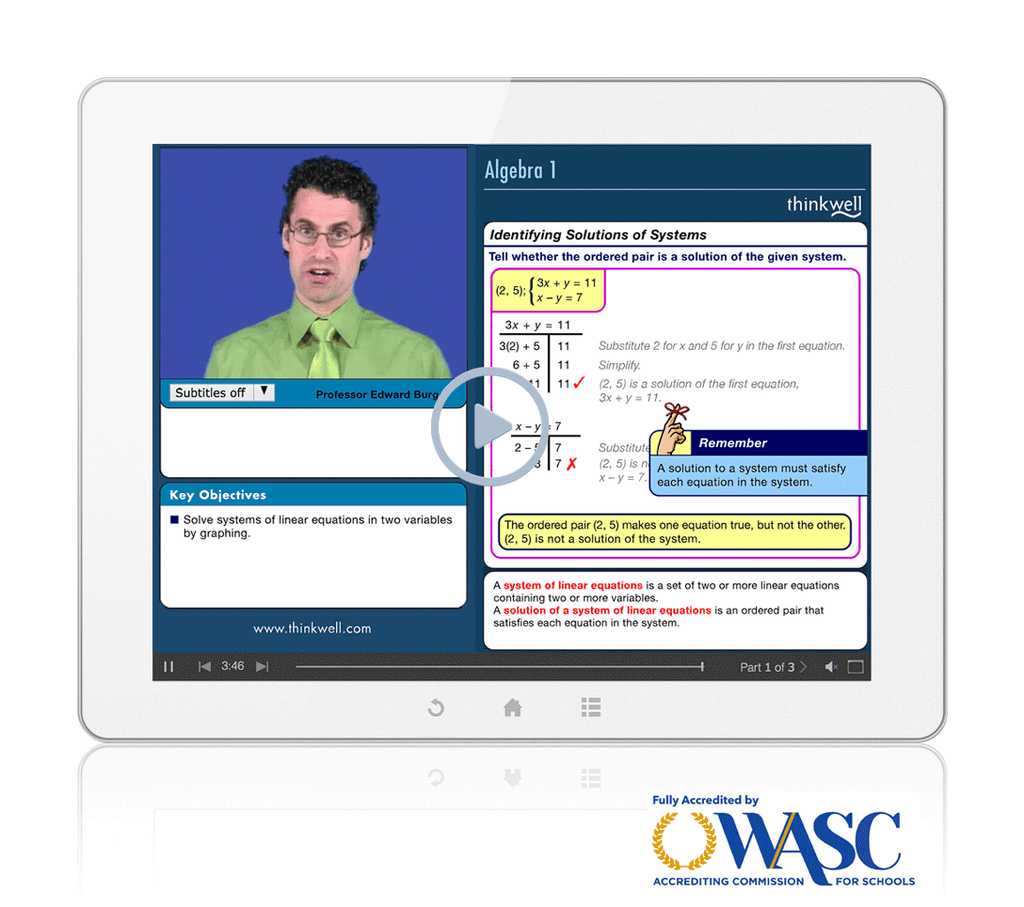
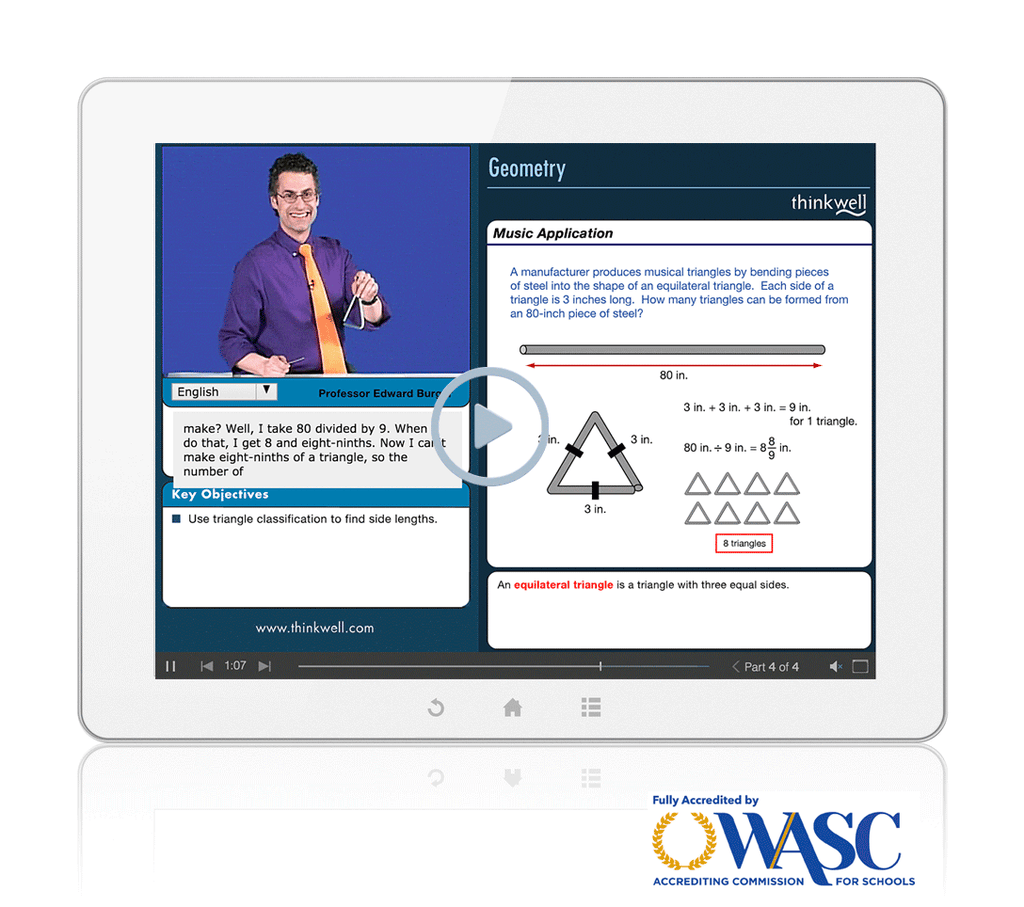
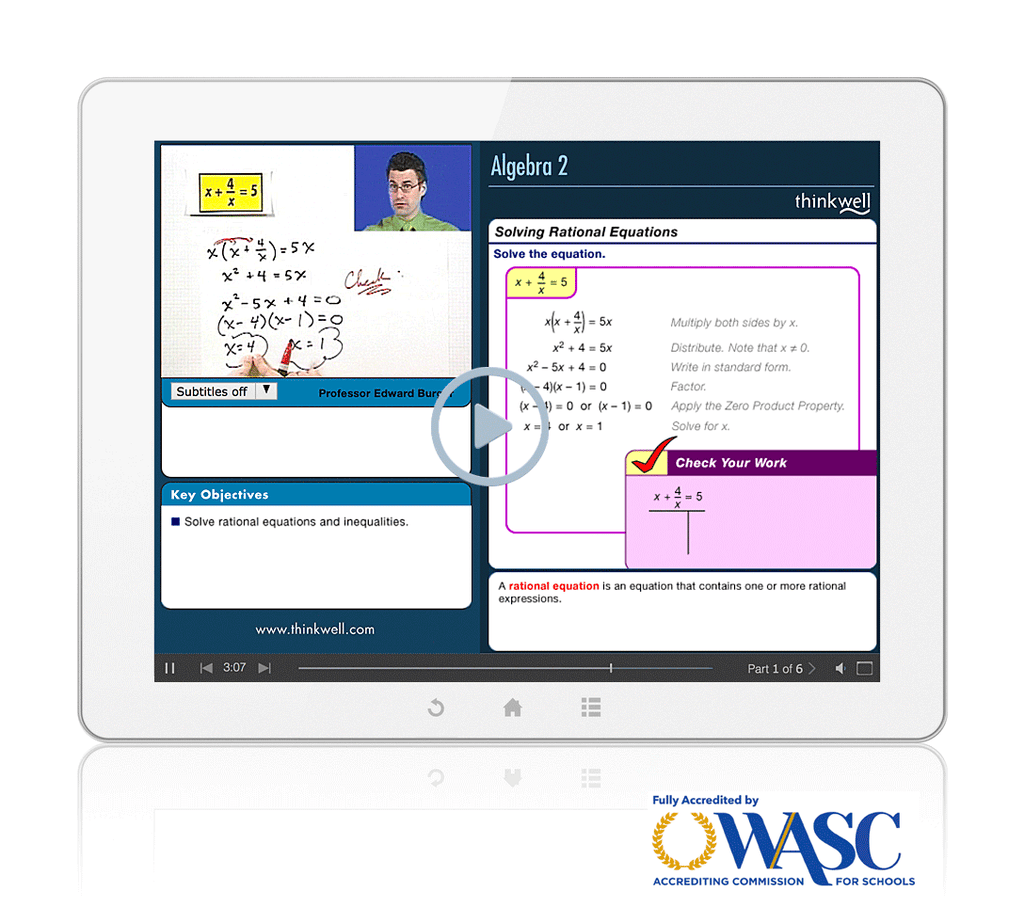
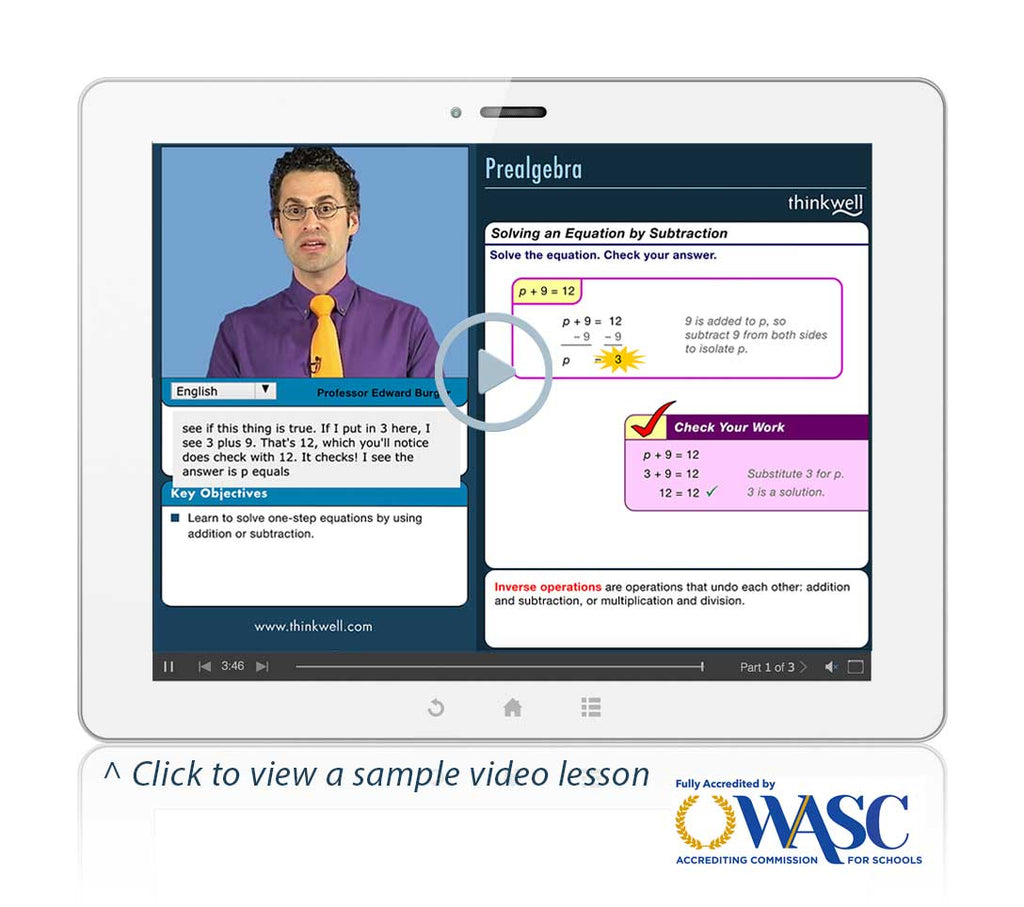
Thinkwell's example-driven video lessons feature award-winning teacher Edward Burger, whose experience and passion make math easy for any homeschool student. In addition, 8th Grade Math includes thousands of automatically graded exercises that help your homeschool students put what they've learned into practice.
Thinkwell's 8th Grade Math has all the features your home school needs:
- Aligned to Grade 8 National Math Standards
- More than 100 topics with 250+ video lessons
- 36-week lesson plan with daily assignments (see lesson plan)
- 92 available contact hours (What is this?)
The number of contact hours in a course reflects the amount of time a student will typically spend completing the assignments in each course (i.e. watching videos, doing exercises, taking exams, etc...). Many people think about contact hours as the "seat time" for a course. Thinkwell provides this information so you can ensure that the amount of instruction in a Thinkwell course meets the standards and requirements for your state or region.
- 1000+ automatically graded exercises allow you to track your progress
- 40 animated interactivities with audio
- Printable 8th grade math worksheets and answer keys for each subchapter and topic
(See sample worksheet - See sample answer key) - 8th grade math tests, including 14 chapter tests, as well as practice tests, a midterm, and a final exam
- Real-world application examples in both lectures and exercises
- Closed captioning for all video lessons (most are also available in Spanish)
- Glossary of more than 200 mathematical terms
- Brand-new content to help students advance their mathematical knowledge:
- simplifying algebraic expressions
- solving linear equations and inequalities
- operations with integers and rational numbers
- relating equations, tables, and graphs
- properties of exponents
- square roots
- Pythagorean Theorem
- ratio, proportion, and percents
- geometry including relationships between lines, angles, and polygons
- 2 and 3-dimensional measurement including perimeter, area, volume, and surface area
- statistics and data displays
- probability
- graphing functions
- writing the equation of a line
- adding, subtracting, and multiplying polynomials
About the Author
Table of Contents
(Expand All - Close All)1. Principles of Algebra
- 1.1 Expressions and Properties of Numbers
- 1.1.1 Introduction to Exponents
- 1.1.2 Using the Order of Operations
- 1.1.3 Variables and Algebraic Expressions
- 1.1.4 Translate Words into Math
- 1.1.5 Properties of Numbers
- 1.2 Operations with Integers
- 1.2.1 Integers
- 1.2.2 Adding Integers
- 1.2.3 Subtracting Integers
- 1.2.4 Multiplying and Dividing Integers
- 1.3 Equations and Inequalities
- 1.3.1 Addition and Subtraction Equations
- 1.3.2 Multiplication and Division Equations
- 1.3.3 Introduction to Inequalities
2. Rational Numbers
- 2.1 Operations with Rational Numbers
- 2.1.1 Rational Numbers
- 2.1.2 Comparing and Ordering Rational Numbers
- 2.1.3 Adding and Subtracting Rational Numbers
- 2.1.4 Multiplying Rational Numbers
- 2.1.5 Dividing Rational Numbers
- 2.2 Equations with Rational Numbers
- 2.2.1 Solving Equations with Rational Numbers
- 2.2.2 Solving Two-Step Equations
3. Graphs, Functions, and Sequences
- 3.1 Tables and Graphs
- 3.1.1 Ordered Pairs
- 3.1.2 Graphing on a Coordinate Plane
- 3.1.3 Interpreting Graphs and Tables
- 3.2 Functions and Sequences
- 3.2.1 Functions
- 3.2.2 Equations, Tables, and Graphs
- 3.2.3 Arithmetic Sequences
4. Exponents and Roots
- 4.1 Properties of Exponents
- 4.1.1 Product and Power Properties of Exponents
- 4.1.2 Integer Exponents
- 4.1.3 Quotient Properties of Exponents
- 4.1.4 An Application of Exponents: Scientific Notation
- 4.2 Square Roots and the Pythagorean Theorem
- 4.2.1 Square Roots and Real Numbers
- 4.2.2 Operations with Square Roots
- 4.2.3 The Pythagorean Theorem and the Distance Formula
5. Proportionality and Measurement
- 5.1 Ratios, Rates, and Proportions
- 5.1.1 Ratios and Proportions
- 5.1.2 Ratios, Rates, and Unit Rates
- 5.1.3 Dimensional Analysis
- 5.1.4 Solving Proportions
- 5.2 Similarity, Scale, and Measurement
- 5.2.1 Similar Figures
- 5.2.2 Dilations
- 5.2.3 Indirect Measurement
- 5.2.4 Scale Drawings and Scale Models
6. Percents
- 6.1 Proportions and Percents
- 6.1.1 Relating Decimals, Fractions, and Percents
- 6.1.2 Estimate with Percents
- 6.1.3 Finding Percents
- 6.1.4 Finding a Number When the Percent is Known
- 6.2 Applying Percents
- 6.2.1 Percent Increase and Decrease
- 6.2.2 Applications of Percents
- 6.2.3 Simple Interest
7. Foundations of Geometry
- 7.1 Points, Lines, and Angles
- 7.1.1 Points, Lines, and Planes
- 7.1.2 Angles and Their Relationships
- 7.1.3 Parallel and Perpendicular Lines_not_in_product_needs_new_video
- 7.2 Polygons
- 7.2.1 Triangles
- 7.2.2 Classifying Polygons
- 7.2.3 Coordinate Geometry
- 7.2.4 Congruence
- 7.3 Patterns in Geometry
- 7.3.1 Transformations
- 7.3.2 Symmetry
- 7.3.3 Tessellations
8. Perimeter, Area, and Volume
- 8.1 Perimeter and Area
- 8.1.1 Perimeter and Area of Rectangles and Parallelograms
- 8.1.2 Perimeter and Area of Triangles and Trapezoids
- 8.1.3 Circles
- 8.2 Three-Dimensional Geometry
- 8.2.1 Drawing Three-Dimensional Figures
- 8.2.2 Volume of Prisms and Cylinders
- 8.2.3 Volume of Pyramids and Cones
- 8.2.4 Surface Area of Prisms and Cylinders
- 8.2.5 Surface Area of Pyramids and Cones
- 8.2.6 Spheres
- 8.2.7 Scaling Three-Dimensional Figures
- 8.2.8 Converting Units of Measurement
9. Data and Statistics
- 9.1 Collecting and Describing Data
- 9.1.1 Samples and Surveys
- 9.1.2 Identifying Sampling Errors and Bias
- 9.1.3 Organizing Data
- 9.1.4 Measures of Central Tendency
- 9.1.5 Variability and Box-and-Whisker Plots
- 9.2 Data Displays
- 9.2.1 Displaying Data
- 9.2.2 Analyzing Data Displays
- 9.2.3 Misleading Graphs and Statistics
- 9.2.4 Scatter Plots
- 9.2.5 Choosing the Best Representation of Data
10. Probability
- 10.1 Experimental Probability
- 10.1.1 Probability
- 10.1.2 Experimental Probability
- 10.1.3 Use a Simulation
- 10.2 Theoretical Probability and Counting
- 10.2.1 Theoretical Probability
- 10.2.2 Independent and Dependent Events
- 10.2.3 Making Decisions and Predictions
- 10.2.4 Odds
- 10.2.5 Counting Principles
- 10.2.6 Permutations and Combinations
11. Multi-Step Equations and Inequalities
- 11.1 Solving Equations
- 11.1.1 Simplifying Algebraic Expressions
- 11.1.2 Solving Multi-Step Equations
- 11.1.3 Solving Equations with Variables on Both Sides
- 11.1.4 Solving Literal Equations
- 11.2 Solving Inequalities and Systems of Equations
- 11.2.1 Solving Inequalities by Multiplying or Dividing
- 11.2.2 Solving Multi-Step Inequalities
- 11.2.3 Systems of Equations
12. Graphing Lines
- 12.1 Linear Equations
- 12.1.1 Graphing Linear Equations
- 12.1.2 Slope of a Line
- 12.1.3 Using Slopes and Intercepts
- 12.1.4 Point-Slope Form
- 12.2 Linear Relationships
- 12.2.1 Direct Variation
- 12.2.2 Graphing Inequalities in Two Variables
- 12.2.3 Solving Systems of Linear Equations By Graphing
- 12.2.4 Lines of Best Fit
13. Sequences and Functions
- 13.1 Sequences
- 13.1.1 Terms of Arithmetic Sequences
- 13.1.2 Terms of Geometric Sequences
- 13.1.3 Other Sequences
- 13.2 Functions
- 13.2.1 Linear Functions
- 13.2.2 Exponential Functions
- 13.2.3 Quadratic Functions
- 13.2.4 Inverse Variation
14. Polynomials
- 14.1 Introduction to Polynomials
- 14.1.1 Introduction to Polynomials
- 14.1.2 Simplifying Polynomials
- 14.2 Operations with Polynomials
- 14.2.1 Adding Polynomials
- 14.2.2 Subtracting Polynomials
- 14.2.3 Multiplying Polynomials by Monomials
- 14.2.4 Multiplying Binomials