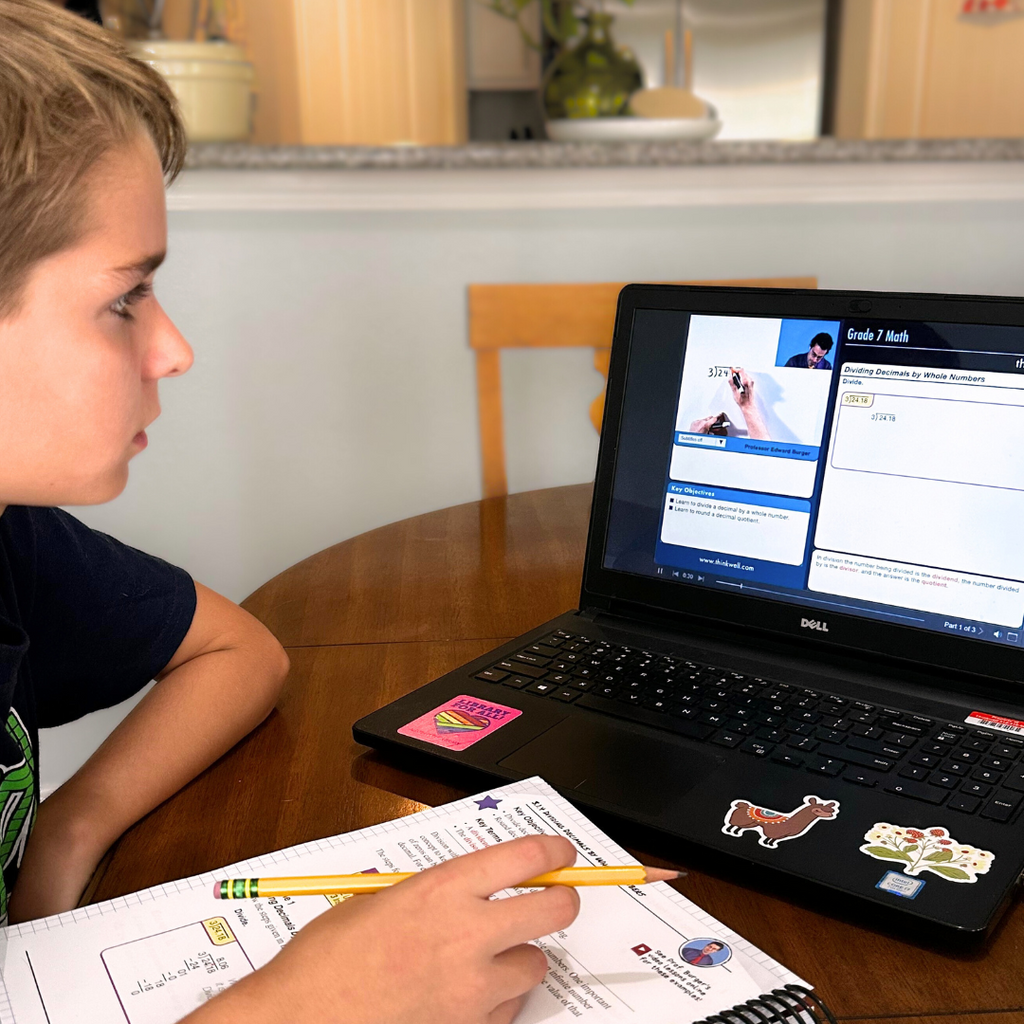
7th Grade Math
- 12-month Online Subscription to our complete 7th Grade Math course with video lessons, day-by-day lesson plans, automatically graded exercises, and much more.
- CD Set (optional) contains all of the video lessons so that you can watch them when you're away from the internet.
7th Grade Math Details
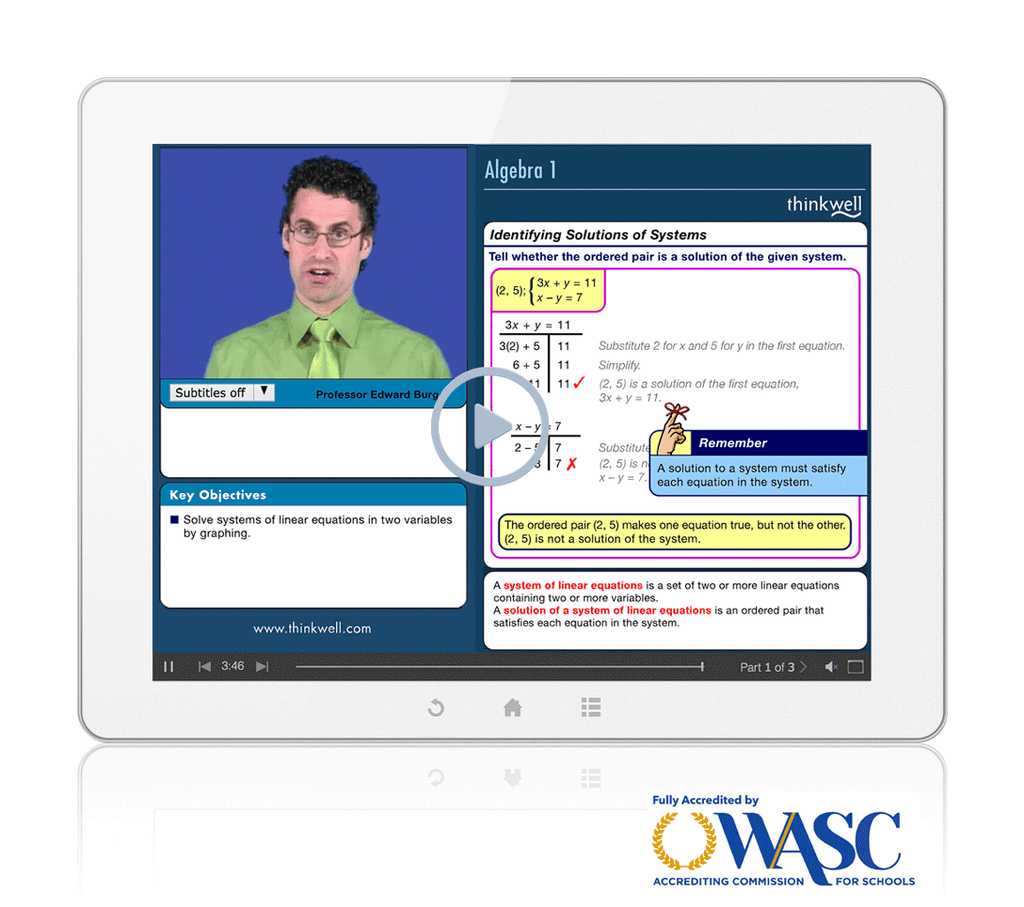
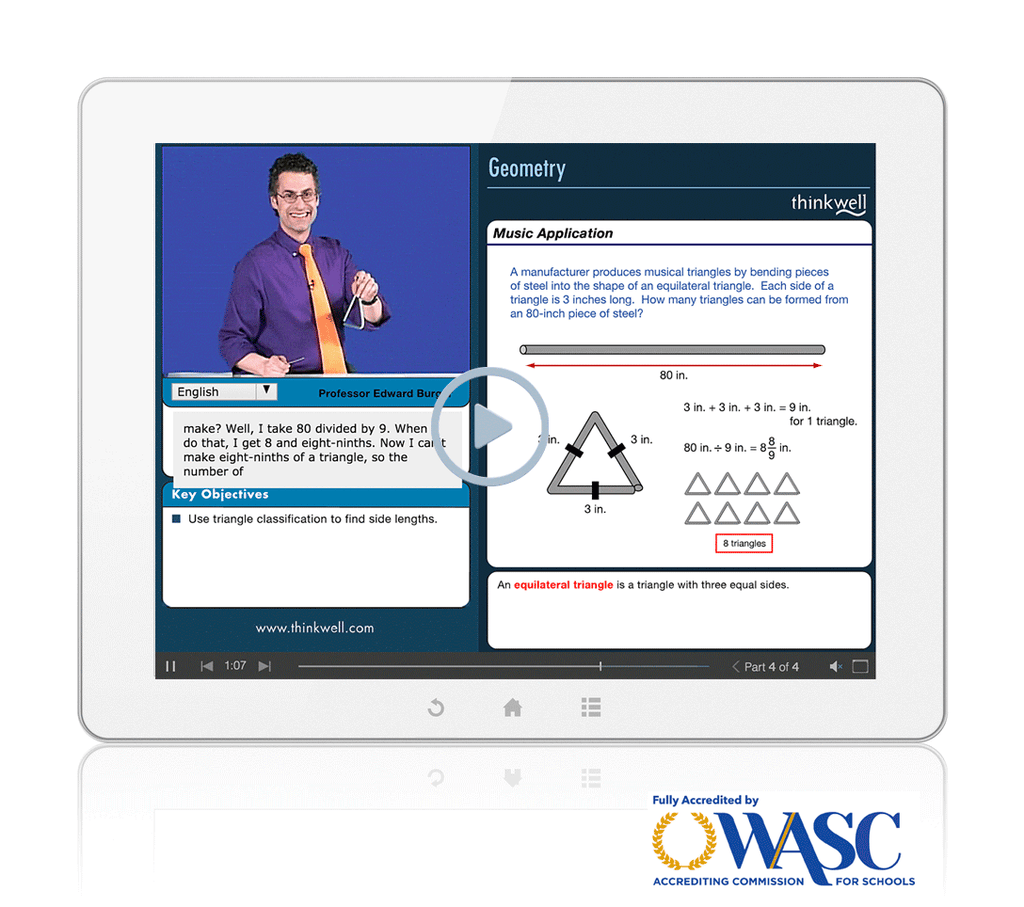
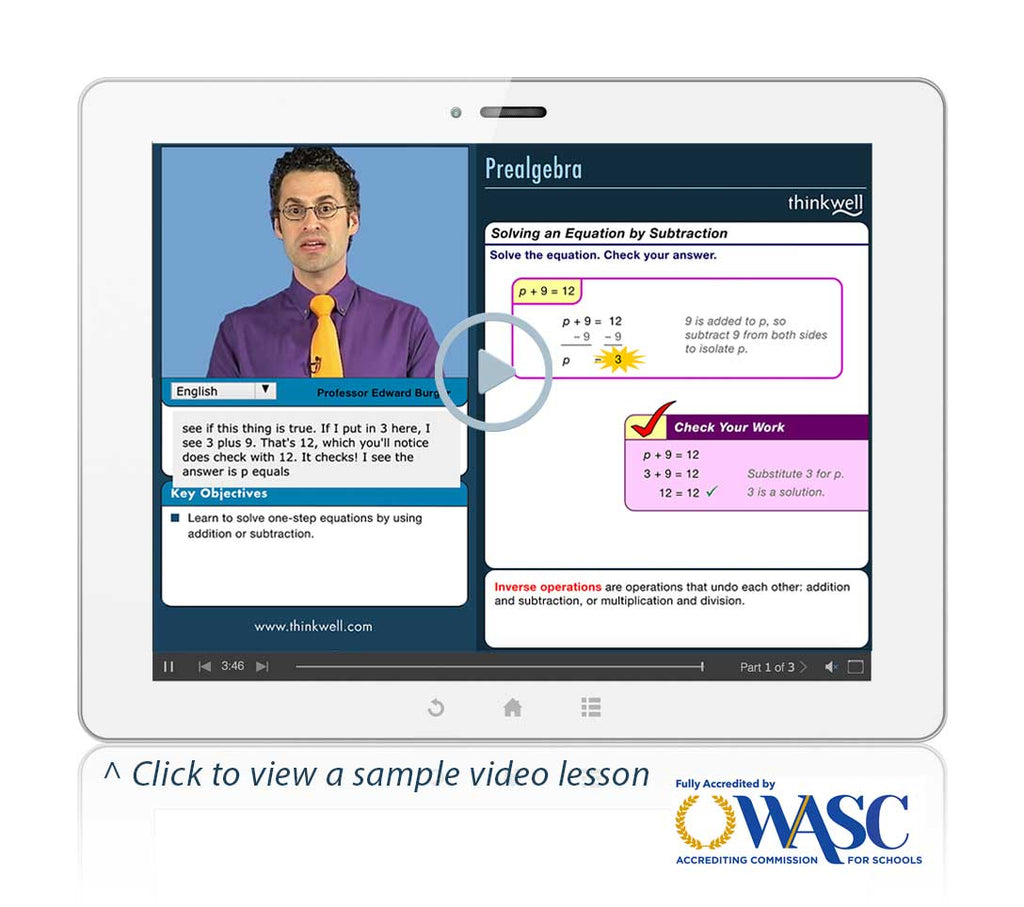
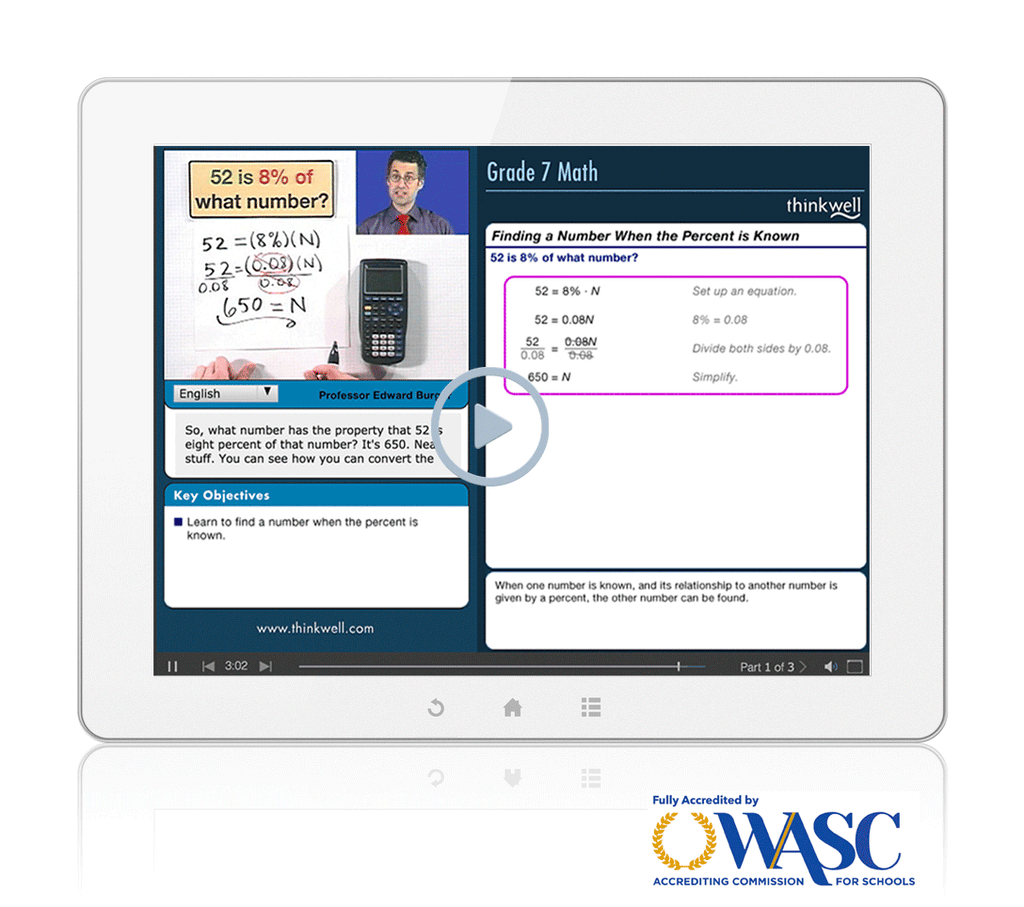
Thinkwell's 7th Grade Math course includes thousands of automatically graded 7th Grade Math problems, printable worksheets for each topic and subchapter, and lots of animated interactivities, and at the core of this complete homeschool course are fun and effective video lessons that students love to use.
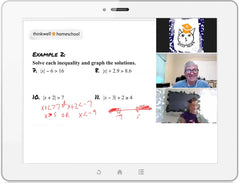
Thinkwell's homeschool video lessons feature Edward Burger, an award-winning teacher with a special talent for making math simple for any student. Your homeschool student will enjoy his sense of humor and his obvious passion for teaching math. Created to work with any learning style, his homeschool video lessons will keep your students engaged and entertained so they'll learn the fundamentals of math easily.
Thinkwell's 7th Grade Math has all the features your home school needs:
- Aligned to Grade 7 National Math Standards
- More than 100 topics with 250+ video lessons
- 34-week lesson plan with daily assignments (see lesson plan)
- 69.6 available contact hours (What is this?)
The number of contact hours in a course reflects the amount of time a student will typically spend completing the assignments in each course (i.e. watching videos, doing exercises, taking exams, etc...). Many people think about contact hours as the "seat time" for a course. Thinkwell provides this information so you can ensure that the amount of instruction in a Thinkwell course meets the standards and requirements for your state or region.
- 1000+ automatically graded exercises allow you to track your progress
- More than 50 interactivities with audio.
- Printable 7th grade math worksheets and answer keys for each subchapter and topic
(See sample worksheet - See sample answer key) - Automatically graded 7th grade math tests, including 12 chapter tests, as well as practice tests, a midterm, and a final exam
- Real-world application examples in both lectures and exercises
- Glossary of more than 200 mathematical terms
- Closed captioning for all video lessons (most are also available in Spanish)
- Brand-new content to help students advance their mathematical knowledge:
- operations with rational numbers (fractions and decimals)
- operations with integers
- solving equations and inequalities
- rates, ratios, percent, and proportions
- square roots
- Pythagorean theorem
- bar graphs, histograms, box-and-whisker plots, and line graphs
- scatter plots
- lines, angles, and polygons
- transformations, dilations, and symmetry
- perimeter and area of polygons
- circumference and area of circles
- volume and surface area of prisms, cylinders, pyramids, and cones
- experimental and theoretical probability
- probability of independent and dependent events
- permutations and combinations
About the Author
Table of Contents
(Expand All - Close All)1. Algebraic Reasoning
- 1.1 Patterns, Operations, and Properties
- 1.1.1 Numbers and Patterns
- 1.1.2 Exponents
- 1.1.3 Applying Exponents: Scientific Notation
- 1.1.4 Order of Operations
- 1.1.5 Properties
- 1.2 Algebraic Expressions and Equations
- 1.2.1 Variables and Algebraic Expressions
- 1.2.2 Translate Words into Math
- 1.2.3 Simplifying Algebraic Expressions
- 1.2.4 Equations and Their Solutions
- 1.2.5 Addition and Subtraction Equations
- 1.2.6 Multiplication and Division Equations
2. Integers and Rational Numbers
- 2.1 Integers
- 2.1.1 Integers
- 2.1.2 Adding Integers
- 2.1.3 Subtracting Integers
- 2.1.4 Multiplying and Dividing Integers
- 2.1.5 Solving Equations Containing Integers
- 2.2 Factors and Multiples
- 2.2.1 Prime Factorization
- 2.2.2 Greatest Common Factor
- 2.2.3 Least Common Multiple
- 2.3 Rational Numbers
- 2.3.1 Equivalent Fractions and Mixed Numbers
- 2.3.2 Equivalent Fractions and Decimals
- 2.3.3 Comparing and Ordering Rational Numbers
3. Operations with Rational Numbers
- 3.1 Operations with Decimals
- 3.1.1 Rounding and Estimating Decimals
- 3.1.2 Adding and Subtracting Decimals
- 3.1.3 Multiplying Decimals
- 3.1.4 Dividing Decimals by Whole Numbers
- 3.1.5 Dividing Decimals
- 3.2 Operations with Fractions
- 3.2.1 Estimating Fraction Sums and Differences
- 3.2.2 Multiplying Fractions and Mixed Numbers
- 3.2.3 Dividing Fractions and Mixed Numbers
- 3.2.4 Adding and Subtracting Fractions and Mixed Numbers
- 3.2.5 Solving Equations with Rational Numbers
4. Proportional Relationships
- 4.1 Ratios, Rates, and Proportions
- 4.1.1 Ratios
- 4.1.2 Rates
- 4.1.3 Identifying and Writing Proportions
- 4.1.4 Solving Proportions
- 4.2 Measurement
- 4.2.1 Customary Measurement
- 4.2.2 Metric Measurements
- 4.2.3 Dimensional Analysis
- 4.2.4 Similar Figures and Proportions
- 4.2.5 Using Similar Figures
- 4.2.6 Scale Drawings and Scale Models
5. Graphs and Functions
- 5.1 Functions, Tables, and Graphs
- 5.1.1 The Coordinate Plane
- 5.1.2 Tables and Graphs
- 5.1.3 Interpreting Graphs
- 5.1.4 Functions, Tables, and Graphs
- 5.1.5 Find the Pattern in Sequences
- 5.2 Linear Functions
- 5.2.1 Graphing Linear Functions
- 5.2.2 Slopes and Rates of Change
- 5.2.3 Slope-Intercept Form
- 5.2.4 Direct Variation
- 5.2.5 Inverse Variation
6. Percents
- 6.1 Proportions and Percents
- 6.1.1 Percents
- 6.1.2 Percents, Decimals, and Fractions
- 6.1.3 Estimating with Percents
- 6.1.4 Finding Percents
- 6.2 Applying Percents
- 6.2.1 Finding a Number When the Percent is Known
- 6.2.2 Percent Increase and Decrease
- 6.2.3 Simple Interest
7. Data
- 7.1 Organizing and Displaying Data
- 7.1.1 Frequency Tables, Stem-and-Leaf Plots, and Line Plots
- 7.1.2 Mean, Median, Mode, and Range
- 7.1.3 Bar Graphs and Histograms
- 7.1.4 Reading and Interpreting Circle Graphs
- 7.1.5 Box-and-Whisker Plots
- 7.2 Representing and Analyzing Data
- 7.2.1 Line Graphs
- 7.2.2 Choosing an Appropriate Display
- 7.2.3 Populations and Samples
- 7.2.4 Scatter Plots
- 7.2.5 Misleading Graphs
8. Geometric Figures
- 8.1 Lines and Angles
- 8.1.1 Points, Lines, and Planes
- 8.1.2 Angles and Their Relationships
- 8.1.3 Geometric Relationships
- 8.2 Circles and Polygons
- 8.2.1 Classifying Polygons
- 8.2.2 Classifying Triangles
- 8.2.3 Classifying Quadrilaterals
- 8.2.4 Angles in Polygons
- 8.3 Transformations
- 8.3.1 Congruent Figures
- 8.3.2 Translations, Reflections, and Rotations
- 8.3.3 Dilations
- 8.3.4 Symmetry
9. Measurement: Two-Dimensional Figures
- 9.1 Perimeter, Circumference, and Area
- 9.1.1 Accuracy and Precision
- 9.1.2 Perimeter and Circumference
- 9.1.3 Area of Parallelograms
- 9.1.4 Area of Triangles and Trapezoids
- 9.1.5 Area of Circles
- 9.1.6 Area of Irregular Figures
- 9.2 Square Roots and the Pythagorean Theorem
- 9.2.1 Squares and Square Roots
- 9.2.2 The Pythagorean Theorem
10. Measurement: Three-Dimensional Figures
- 10.1 Volume
- 10.1.1 Introduction to Three-Dimensional Figures
- 10.1.2 Volume of Prisms and Cylinders
- 10.1.3 Volume of Pyramids and Cones
- 10.2 Surface Area
- 10.2.1 Surface Area of Prisms and Cylinders
- 10.2.2 Surface Area of Pyramids and Cones
- 10.2.3 Changing Dimensions
11. Probability
- 11.1 Introduction to Probability
- 11.1.1 Probability
- 11.1.2 Experimental Probability
- 11.1.3 Make a List to Find Sample Spaces
- 11.1.4 Theoretical Probability
- 11.2 Applications of Probability
- 11.2.1 Making Predictions
- 11.2.2 Probability of Independent and Dependent Events
- 11.2.3 Combinations
- 11.2.4 Permutations
12. Multi-Step Equations and Inequalities
- 12.1 Multi-Step Equations
- 12.1.1 Solving Two-Step Equations
- 12.1.2 Solving Multi-Step Equations
- 12.1.3 Solving Equations with Variables on Both Sides
- 12.2 Inequalities
- 12.2.1 Inequalities
- 12.2.2 Solving Inequalities by Adding or Subtracting
- 12.2.3 Solving Inequalities by Multiplying or Dividing
- 12.2.4 Solving Two-Step Inequalities