AP Chemistry
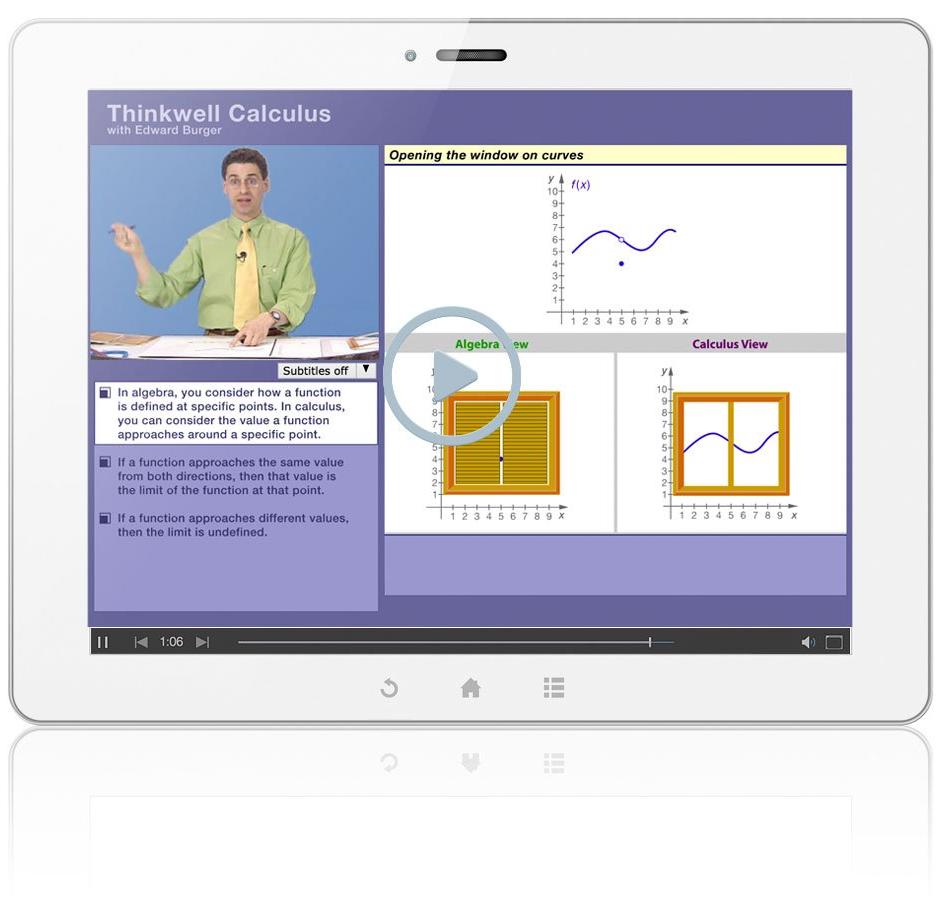
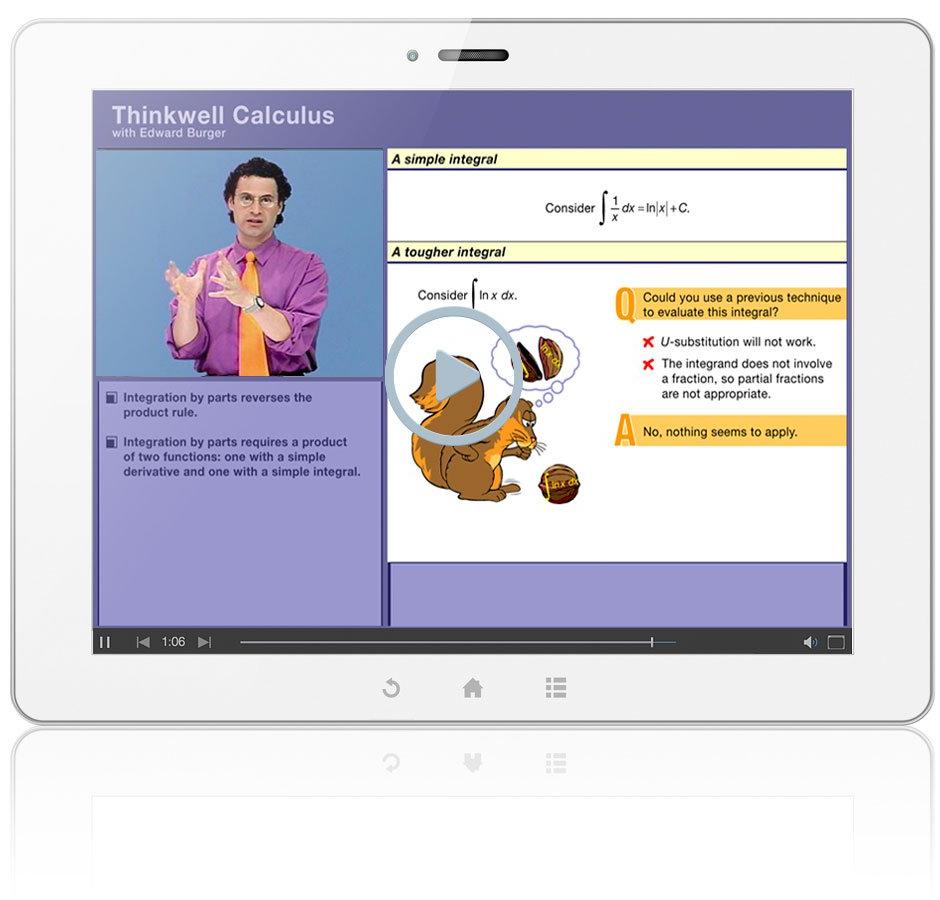
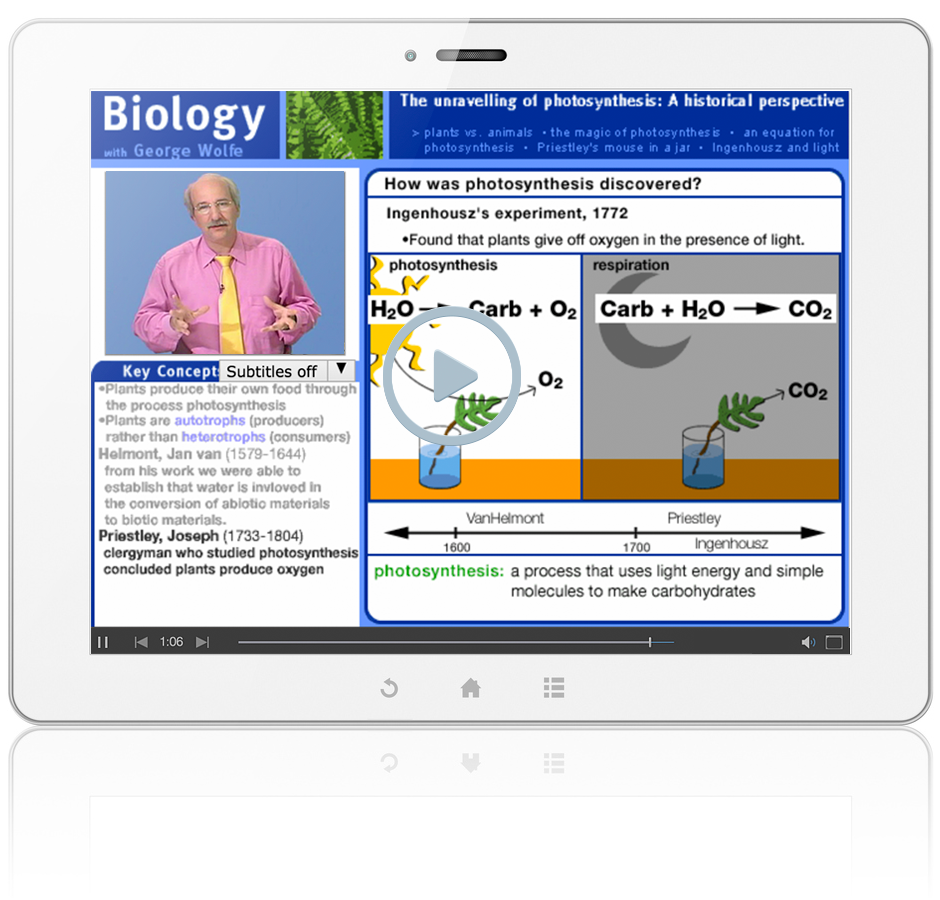
- 12-month Online Subscription to our complete AP Chemistry course with video lessons, day-by-day lesson plans, automatically graded exercises, and much more.
- CD Set (optional) contains all of the video lessons so that you can watch them when you're away from the internet.
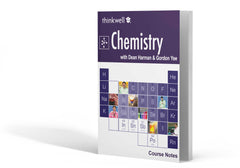
- Printed Notes (optional) are the AP Chemistry course notes from the Online Subscription, but in a printed, on-the-go format.
AP Chemistry details
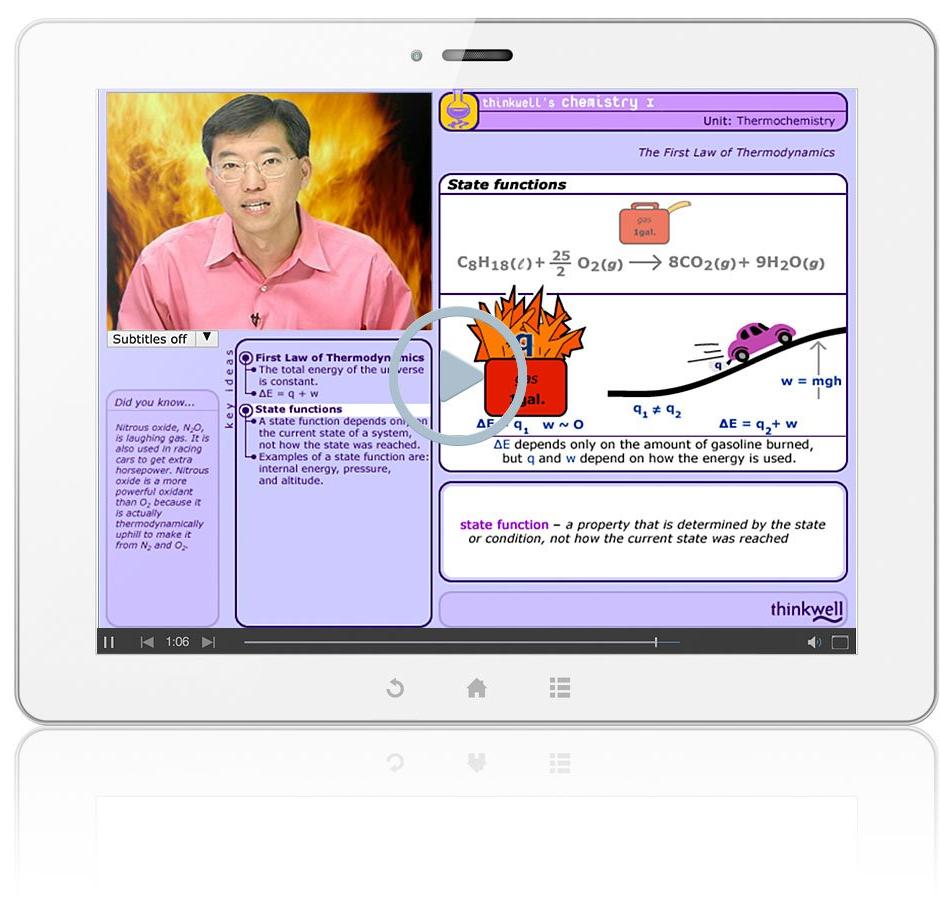
Thinkwell's AP Chemistry features the world's best AP Chemistry teachers teaching the fundamentals and advanced concepts of AP Chemistry. Award-winning teachers Gordon Yee and Dean Harmon explain everything your student needs to succeed in the classroom portion of AP Chemistry and to score a perfect 5 on the AP Chemistry exam.
Though similar to our college-level chemistry course, AP Chemistry also includes diagnostic assessments geared toward AP exam preparation.
Thinkwell's Chemistry includes all of these features to prepare you for the big exam:
- Equivalent to 11th- or 12th-grade AP Chemistry
- More than 260 video lessons
- 176 available contact hours (What is this?)
The number of contact hours in a course reflects the amount of time a student will typically spend completing the assignments in each course (i.e. watching videos, doing exercises, taking exams, etc...). Many people think about contact hours as the "seat time" for a course. Thinkwell provides this information so you can ensure that the amount of instruction in a Thinkwell course meets the standards and requirements for your state or region.
- 37-week lesson plan with daily assignments (see lesson plan)
- 1000+ interactive AP chemistry problems with immediate feedback allow you to track your progress (See sample)
- Diagnostic tests that tell you exactly what you need to study
- AP Chemistry chapter tests for all 22 chapters, as well as midterm and final exams to make sure you're ready for the AP Chemistry exam
- Printable illustrated notes for each topic
- Closed captioning for all videos
- Glossary of more than 850 chemistry terms
- Engaging content to help students advance their knowledge of chemistry:
- Atoms, molecules, and ions
- Stoichiometry and the mole
- Reactions in aqueous solutions
- Gases, liquids, and solids
- Modern atomic theory and quantum mechanics
- Electron configurations and periodicity
- Chemical bonding and reactions
- Properties of solutions
- Acids and bases
- Thermochemistry, electrochemistry, and biochemistry
About the Author
Table of Contents
(Expand All - Close All)1. An Introduction to Matter and Measurement
- 1.1 An Introduction to Chemistry and the Scientific Method
- 1.1.1 An Introduction to Chemistry
- 1.1.2 The Scientific Method
- 1.2 Properties of Matter
- 1.2.1 States of Matter
- 1.2.2 A Word About Laboratory Safety
- 1.2.3 CIA Demonstration: Differences in Density Due to Temperature
- 1.2.4 Properties of Matter
- 1.3 Scientific Measurement
- 1.3.1 The Measurement of Matter
- 1.3.2 Precision and Accuracy
- 1.3.3 CIA Demonstration: Precision and Accuracy with Glassware
- 1.3.4 Significant Figures
- 1.3.5 Dimensional Analysis
- 1.4 Mathematics of Chemistry
- 1.4.1 Scientific (Exponential) Notation
- 1.4.2 Common Mathematical Functions
2. Atoms, Molecules, and Ions
- 2.1 Early Atomic Theory
- 2.1.1 Early Discoveries and the Atom
- 2.1.2 Understanding Electrons
- 2.1.3 Understanding the Nucleus
- 2.2 Atomic Structure
- 2.2.1 Mass Spectrometry: Determining Atomic Masses
- 2.2.2 Examining Atomic Structure
- 2.2.3 CIA Demonstration: Flame Colors
- 2.3 The Periodic Table
- 2.3.1 Creating the Periodic Table
- 2.4 Chemical Nomenclature
- 2.4.1 Describing Chemical Formulas
- 2.4.2 Naming Chemical Compounds
- 2.4.3 Organic Nomenclature
3. Stoichiometry
- 3.1 Chemical Equations
- 3.1.1 An Introduction to Chemical Reactions and Equations
- 3.1.2 CIA Demonstration: Magnesium and Dry Ice
- 3.1.3 Balancing Chemical Equations
- 3.2 The Mole
- 3.2.1 The Mole and Avogadro's Number
- 3.2.2 Introducing Conversions of Masses, Moles, and Number of Particles
- 3.3 Solving Problems Involving Mass/Mole Relationships
- 3.3.1 Finding Empirical and Molecular Formulas
- 3.3.2 Stoichiometry and Chemical Equations
- 3.3.3 Finding Limiting Reagents
- 3.3.4 CIA Demonstration: Self-Inflating Hydrogen Balloons
- 3.3.5 Theoretical Yield and Percent Yield
- 3.3.6 A Problem Using the Combined Concepts of Stoichiometry
4. Reactions in Aqueous Solutions
- 4.1 An Introduction to Solutions
- 4.1.1 Properties of Solutions
- 4.1.2 CIA Demonstration: The Electric Pickle
- 4.1.3 Concentrations of Solutions
- 4.1.4 Factors Determining Solubility
- 4.2 Reactions Involving Solutions
- 4.2.1 Precipitation Reactions
- 4.2.2 Acid-Base Reactions
- 4.2.3 Oxidation-Reduction Reactions
- 4.3 Stoichiometry Problems in Solutions
- 4.3.1 Acid-Base Titrations
- 4.3.2 Solving Titration Problems
- 4.3.3 Gravimetric Analysis
5. Gases
- 5.1 Gases and Gas Laws
- 5.1.1 Properties of Gases
- 5.1.2 Boyle's Law
- 5.1.3 Charles's Law
- 5.1.4 The Combined Gas Law
- 5.1.5 Avogadro's Law
- 5.1.6 CIA Demonstration: The Potato Cannon
- 5.2 The Ideal Gas Law and Kinetic-Molecular Theory of Gases
- 5.2.1 The Ideal Gas Law
- 5.2.2 Partial Pressure and Dalton's Law
- 5.2.3 Applications of the Gas Laws
- 5.2.4 The Kinetic-Molecular Theory of Gases
- 5.2.5 CIA Demonstration: The Ammonia Fountain
- 5.3 Molecular Motion of Gases
- 5.3.1 Molecular Speeds
- 5.3.2 Effusion and Diffusion
- 5.4 Behavior of Real Gases
- 5.4.1 Comparing Real and Ideal Gases
6. Thermochemistry
- 6.1 An Introduction to Energy
- 6.1.1 The Nature of Energy
- 6.1.2 Energy, Calories, and Nutrition
- 6.1.3 The First Law of Thermodynamics
- 6.1.4 Work
- 6.1.5 Heat
- 6.1.6 CIA Demonstration: Cool Fire
- 6.2 Enthalpy
- 6.2.1 Heats of Reaction: Enthalpy
- 6.2.2 CIA Demonstration: The Thermite Reaction
- 6.3 Calorimetry
- 6.3.1 Constant Pressure Calorimetry
- 6.3.2 Bomb Calorimetry (Constant Volume)
- 6.4 Hess's Law and Enthalpies of Formation
- 6.4.1 Hess's Law
- 6.4.2 Enthalpies of Formation
7. Modern Atomic Theory
- 7.1 Electromagnetic Radiation and the Idea of Quantum
- 7.1.1 The Wave Nature of Light
- 7.1.2 Absorption and Emission
- 7.1.3 CIA Demonstration: Luminol
- 7.1.4 The Ultraviolet Catastrophe
- 7.1.5 The Photoelectric Effect
- 7.1.6 The Bohr Model
- 7.1.7 The Heisenberg Uncertainty Principle
- 7.2 Quantum Mechanics
- 7.2.1 The Wave Nature of Matter
- 7.2.2 Radial Solutions to the Schrödinger Equation
- 7.2.3 Angular Solutions to the Schrödinger Equation
- 7.3 Atomic Orbitals
- 7.3.1 Atomic Orbital Size
- 7.3.2 Atomic Orbital Shapes and Quantum Numbers
- 7.3.3 Atomic Orbital Energy
8. Electron Configurations and Periodicity
- 8.1 Electron Spin and the Pauli Exclusion Principle
- 8.1.1 Understanding Electron Spin
- 8.1.2 Electron Shielding
- 8.1.3 Electron Configurations through Neon
- 8.1.4 Electron Configurations beyond Neon
- 8.1.5 Periodic Relationships
- 8.2 Periodicity
- 8.2.1 Periods and Atomic Size
- 8.2.2 Ionization Energy
- 8.2.3 Electron Affinity
- 8.2.4 An Introduction to Electronegativity
- 8.3 Group Trends
- 8.3.1 Hydrogen, Alkali Metals and Alkaline Earth Metals
- 8.3.2 Transition Metals and Nonmetals
9. Chemical Bonding: Fundamental Concepts
- 9.1 Valence Electrons and Chemical Bonding
- 9.1.1 Valence Electrons and Chemical Bonding
- 9.1.2 Ionic Bonds
- 9.1.3 CIA Demonstration: Conductivity Apparatus-Ionic versus Covalent Bonds
- 9.2 Lewis Dot Structures
- 9.2.1 Lewis Dot Structures for Covalent Bonds
- 9.2.2 Predicting Lewis Dot Structures
- 9.3 Resonance Structures and Formal Charge
- 9.3.1 Resonance Structures
- 9.3.2 Formal Charge
- 9.3.3 Electronegativity, Formal Charge, and Resonance
- 9.4 Bond Properties
- 9.4.1 Bond Properties
- 9.4.2 Using Bond Dissociation Energies
10. Molecular Geometry and Bonding Theory
- 10.1 Molecular Geometry and the VSEPR Theory
- 10.1.1 Valence-Shell Electron-Pair Repulsion Theory
- 10.1.2 Molecular Shapes for Steric Numbers 2-4
- 10.1.3 Molecular Shapes for Steric Numbers 5 & 6
- 10.1.4 Predicting Molecular Characteristics Using VSEPR Theory
- 10.2 Valence Bond Theory and Molecular Orbital Theory
- 10.2.1 Valence Bond Theory
- 10.2.2 An Introduction to Hybrid Orbitals
- 10.2.3 Pi Bonds
- 10.2.4 Molecular Orbital Theory
- 10.2.5 Applications of the Molecular Orbital Theory
- 10.2.6 Beyond Homonuclear Diatomics
- 10.2.7 CIA Demonstration: The Paramagnetism of Oxygen
11. Oxidation-Reduction Reactions
- 11.1 Looking In-Depth at Redox Reactions
- 11.1.1 Oxidation Numbers
- 11.1.2 Balancing Redox Reactions by the Oxidation Number Method
- 11.1.3 Balancing Redox Reactions Using the Half-Reaction Method
- 11.1.4 The Activity Series of the Elements
- 11.1.5 CIA Demonstration: The Reaction between Al and Br2
12. Condensed Phases: Liquids and Solids
- 12.1 Intermolecular Forces
- 12.1.1 An Introduction to Intermolecular Forces and States of Matter
- 12.1.2 Intermolecular Forces
- 12.2 Physical Properties of Liquids
- 12.2.1 Properties of Liquids
- 12.2.2 CIA Demonstration: Boiling Water at Reduced Pressure
- 12.2.3 Vapor Pressure and Boiling Point
- 12.2.4 Molecular Structure and Boiling Point
- 12.2.5 Phase Diagrams
- 12.2.6 CIA Demonstration: Boiling Water in a Paper Cup
- 12.3 Solid State: Structure and Bonding
- 12.3.1 Types of Solids
- 12.3.2 CIA Demonstration: The Conductivity of Molten Salts
- 12.3.3 Crystal Structure
- 12.3.4 Calculating Atomic Mass and Radius from a Unit Cell
- 12.3.5 Crystal Packing
13. Physical Properties of Solutions
- 13.1 Characterizing Solutions
- 13.1.1 Types of Solutions
- 13.1.2 Molarity and the Mole Fraction
- 13.1.3 Molality
- 13.1.4 Energy and the Solution Process
- 13.2 Effects of Temperature and Pressure on Solubility
- 13.2.1 Temperature Change and Solubility
- 13.2.2 Extractions
- 13.2.3 Pressure Change and Solubility
- 13.3 Colligative Properties
- 13.3.1 Vapor Pressure Lowering
- 13.3.2 Boiling Point Elevation and Freezing Point Depression
- 13.3.3 Boiling Point Elevation Problem
- 13.3.4 Osmosis
- 13.3.5 Colligative Properties of Ionic Solutions
14. Chemical Kinetics
- 14.1 Reaction Rates
- 14.1.1 An Introduction to Reaction Rates
- 14.1.2 Rate Laws: How the Reaction Rate Depends on Concentration
- 14.1.3 Determining the Form of a Rate Law
- 14.2 Orders of Reaction
- 14.2.1 First-Order Reactions
- 14.2.2 Second-Order Reactions
- 14.2.3 A Kinetics Problem
- 14.3 Temperature and Rates
- 14.3.1 The Collision Model
- 14.3.2 The Arrhenius Equation
- 14.3.3 Using the Arrhenius Equation
- 14.4 Reaction Mechanisms
- 14.4.1 Defining the Molecularity of a Reaction
- 14.4.2 Determining the Rate Laws of Elementary Reactions
- 14.4.3 Calculating the Rate Laws of Multistep Reactions
- 14.4.4 Steady State Kinetics
- 14.5 Catalysts
- 14.5.1 Catalysts and Types of Catalysts
- 14.5.2 A Word About Laboratory Safety
- 14.5.3 CIA Demonstration: Elephant Snot
- 14.5.4 CIA Demonstration: The Cobalt(II)-Catalyzed Reaction of Potassium Sodium Tartrate
- 14.5.5 CIA Demonstration: The Copper-Catalyzed Decomposition of Acetone
15. Chemical Equilibrium
- 15.1 Principles of Chemical Equilibrium
- 15.1.1 The Concept of Equilibrium
- 15.1.2 The Law of Mass Action and Types of Equilibrium
- 15.1.3 Converting Between Kc and Kp
- 15.2 Using Equilibrium Constants
- 15.2.1 Approaching Chemical Equilibrium
- 15.2.2 Predicting the Direction of a Reaction
- 15.2.3 Strategies for Solving Equilibrium Problems
- 15.2.4 Solving Problems Far from Equilibrium
- 15.2.5 An Equilibrium Problem Using the Quadratic Equation
- 15.3 Shifting Chemical Equilibrium
- 15.3.1 Le Châtelier's Principle
- 15.3.2 The Effect of Changing Amounts on Equilibrium
- 15.3.3 The Effect of Pressure and Volume on Equilibrium
- 15.3.4 The Effects of Temperature and Catalysts on Equilibrium
- 15.3.5 CIA Demonstration: NO2/N2O4
- 15.3.6 CIA Demonstration: Shifting the Equilibrium of FeSCN2+
16. Acids and Bases
- 16.1 Acid-Base Concepts
- 16.1.1 Arrhenius/Brønsted-Lowry Definitions of Acids and Bases
- 16.1.2 Hydronium, Hydroxide, and the pH Scale
- 16.2 Acid and Base Strengths
- 16.2.1 Strong Acids and Bases
- 16.2.2 CIA Demonstration: Natural Acid-Base Indicators
- 16.2.3 Weak Acids
- 16.2.4 Weak Bases
- 16.2.5 Lewis Acids and Bases
- 16.2.6 Trends in Acid and Base Strengths
17. Equilibrium in Aqueous Solution
- 17.1 Reactions of Acids and Bases
- 17.1.1 Strong Acid-Strong Base and Weak Acid-Strong Base Reactions
- 17.1.2 Strong Acid-Weak Base and Weak Acid-Weak Base Reactions
- 17.1.3 The Common Ion Effect
- 17.2 Buffers
- 17.2.1 An Introduction to Buffers
- 17.2.2 CIA Demonstration: Buffers in Action
- 17.2.3 Acidic Buffers
- 17.2.4 Basic Buffers
- 17.2.5 The Henderson-Hasselbalch Equation
- 17.3 Acid-Base Titration
- 17.3.1 Strong Acid-Strong Base Titration
- 17.3.2 CIA Demonstration: Barium Hydroxide-Sulfuric Acid Titration
- 17.3.3 Weak Acid-Strong Base Titration
- 17.3.4 Polyprotic Acid-Strong Base Titration
- 17.3.5 Weak Base-Strong Acid Titration
- 17.3.6 Acid-Base Indicators
- 17.4 Solubility Equilibria
- 17.4.1 The Solubility Product Constant
- 17.4.2 CIA Demonstration: Silver Chloride and Ammonia
- 17.4.3 Solubility and the Common Ion Effect
- 17.4.4 Fractional Precipitation
18. Thermodynamics
- 18.1 An Introduction to Thermodynamics
- 18.1.1 Spontaneous Processes
- 18.2 Entropy
- 18.2.1 Entropy and the Second Law of Thermodynamics
- 18.2.2 Entropy and Temperature
- 18.3 Gibbs Free Energy and Free Energy Change
- 18.3.1 Gibbs Free Energy
- 18.3.2 Standard Free Energy Changes of Formation
- 18.4 Using Free Energy
- 18.4.1 Enthalpy and Entropy Contributions to K
- 18.4.2 The Temperature Dependence of K
- 18.4.3 Free Energy Away from Equilibrium
19. Electrochemistry
- 19.1 Principles of Electrochemistry
- 19.1.1 Reviewing Oxidation-Reduction Reactions
- 19.2 Galvanic Cells
- 19.2.1 Electrochemical Cells
- 19.2.2 Electromotive Force
- 19.2.3 Standard Reduction Potentials
- 19.2.4 Using Standard Reduction Potentials
- 19.2.5 The Nernst Equation
- 19.2.6 Electrochemical Determinants of Equilibria
- 19.3 Batteries
- 19.3.1 Batteries
- 19.3.2 CIA Demonstration: The Fruit-Powered Clock
- 19.4 Corrosion
- 19.4.1 Corrosion and the Prevention of Corrosion
- 19.5 Electrolysis and Electrolytic Cells
- 19.5.1 Electrolytic Cells
- 19.5.2 The Stoichiometry of Electrolysis
20. Nuclear Chemistry
- 20.1 Radioactivity
- 20.1.1 The Nature of Radioactivity
- 20.1.2 The Stability of Atomic Nuclei
- 20.1.3 Binding Energy
- 20.2 Rates of Disintegration
- 20.2.1 Rates of Disintegration Reactions
- 20.2.2 Radiochemical Dating
- 20.3 Nuclear Fission and Fusion
- 20.3.1 Nuclear Fission
- 20.3.2 Nuclear Fusion
- 20.3.3 Applications of Nuclear Chemistry
21. Chemistry of Metals
- 21.1 An Introduction to Metals
- 21.1.1 Metallurgical Processes
- 21.1.2 Band Theory of Conductivity
- 21.1.3 Intrinsic Semiconductors
- 21.1.4 Doped Semiconductors
- 21.2 Physical and Chemical Processes of Metals
- 21.2.1 The Alkali Metals
- 21.2.2 The Alkaline Earth Metals
- 21.2.3 Aluminum
- 21.2.4 CIA Demonstration: The Reaction between Al and Br2
22. Nonmetals
- 22.1 An Introduction to Nonmetals and Hydrogen
- 22.1.1 General Properties of Nonmetals
- 22.1.2 Hydrogen
- 22.2 Group 14: Carbon and Silicon
- 22.2.1 General Properties of Carbon
- 22.2.2 Silicon
- 22.3 Group 15: Nitrogen and Phosphorus
- 22.3.1 Nitrogen
- 22.3.2 Phosphorus
- 22.4 Group 16: Oxygen and Sulfur
- 22.4.1 Oxygen
- 22.4.2 CIA Demonstration: Creating Acid Rain
- 22.4.3 Sulfur
- 22.5 Group 17: The Halogens
- 22.5.1 Halogens
- 22.5.2 Aqueous Halogen Compounds
- 22.6 Group 18: The Noble Gases
- 22.6.1 Properties of Noble Gases
23. Instructional Laboratory Demonstrations
- 23.1 Laboratory Techniques
- 23.1.1 CIA Demonstration: Laboratory Safety
- 23.1.2 CIA Demonstration: Chromatography
- 23.1.3 CIA Demonstration: Distillation
- 23.1.4 CIA Demonstration: Pipetting
- 23.1.5 CIA Demonstration: Dilutions
- 23.1.6 CIA Demonstration: Titrations
- 23.1.7 CIA Demonstration: Extractions
- 23.1.8 CIA Demonstration: Filtrations
- 23.1.9 CIA Demonstration: Weighing on an Analytical Balance
- 23.1.10 CIA Demonstration: Recrystallization